
A Product-Video-from-Photos Workflow
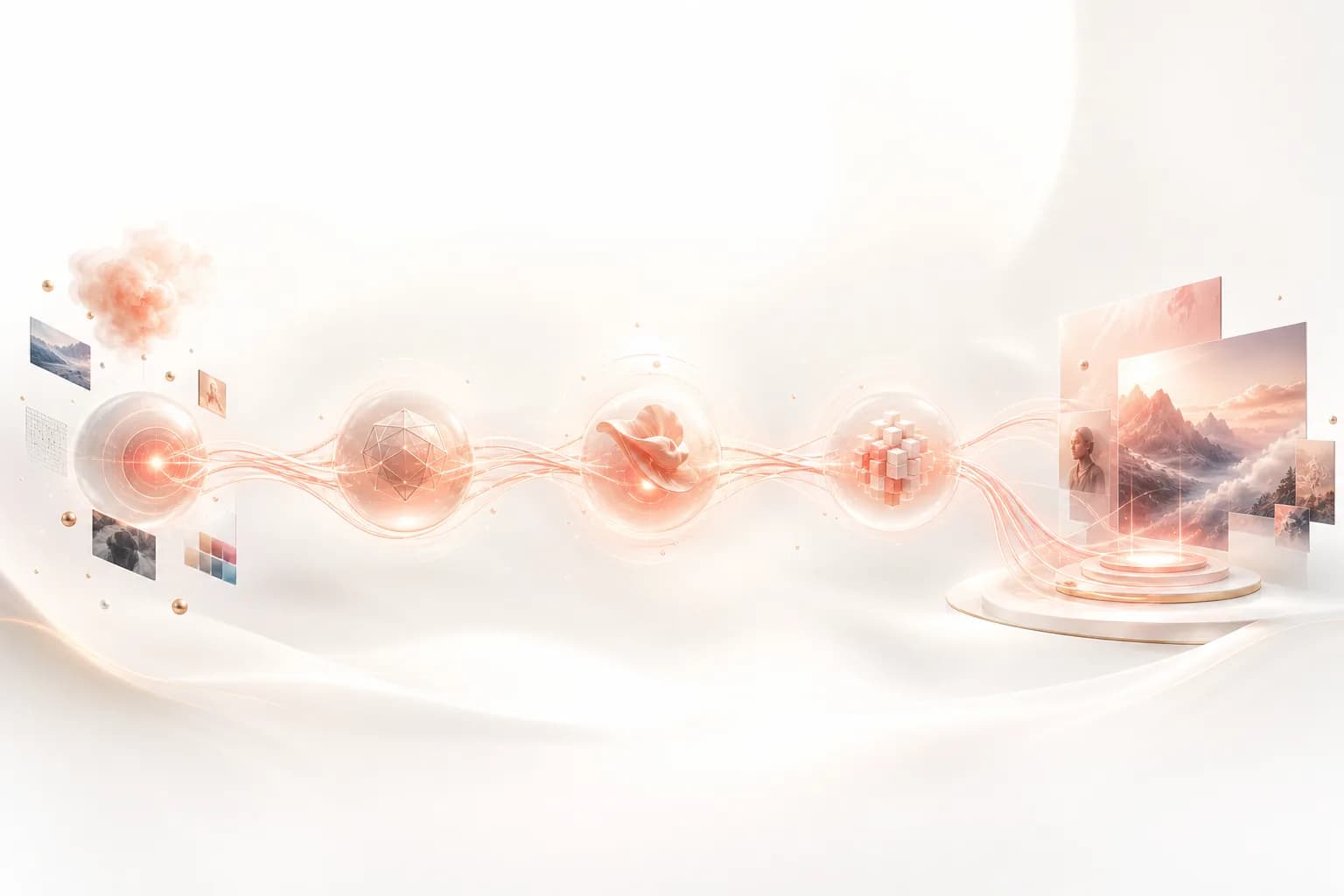
Converting a set of static product photos into a polished promotional video — with smooth camera moves, transitions, background environments, and branded motion elements — is one of the most commercially valuable applications of AI video workflows. This guide walks through building a product-video-from-photos pipeline in the Floniks editor: selecting and sequencing source photos, animating each still with appropriate camera motion, generating environment backgrounds, chaining transitions, and adding branded outro elements. You will leave with a reusable template that produces a publication-ready product video from any set of stills without a shoot day or editing suite.
The Business Case for Still-to-Video at Scale
E-commerce brands and product marketers consistently report that video content outperforms static images in conversion rate on product pages, in paid social ads, and in email campaigns. Yet video production has historically required a separate shoot day with video equipment, a videographer, and significant post-production time — resources that most brands cannot deploy for every SKU in their catalog. The result is a stark division: hero products get video treatment, and the rest of the catalog gets static images that underperform.
AI still-to-video workflows close this gap. If a brand already has high-quality product photos — and most do, for their e-commerce listings — those stills can become the input layer for a video generation workflow that adds camera motion, environmental context, and branded elements. The workflow does not require the product to be re-photographed in motion; it synthesizes plausible motion from the static geometry visible in the photograph, adds environmental backgrounds that complement the product context, and assembles the shots into a finished clip with transitions and branding.
The economic impact is significant. A brand with 200 SKUs can produce a product video for each SKU in a single batch run rather than scheduling 200 individual video productions. The consistency across the catalog is also higher than a traditional production approach because every video follows the same template — same motion grammar, same transition style, same branded outro — regardless of which team member operates the workflow.
Selecting and Sequencing Source Photos
The quality of the product video is directly constrained by the quality of the input photos. Before building the workflow, select the optimal photos for animation — not necessarily the most traditional e-commerce angles, but the angles that provide the most information about product depth, texture, and form, since the motion generation model uses this information to synthesize plausible 3D camera movement.
Photos with clear foreground-to-background depth cues animate more convincingly than flat overhead or straight-on product shots. A three-quarter angle that shows the front face, one side face, and some of the top surface gives the model enough spatial information to animate a credible dolly-in or orbit move. A pure front-on flat-lay shot will produce a zoom rather than a camera orbit because there is no lateral depth information.
For a standard product video, select 3–5 shots: a main beauty shot for the opening, a detail or texture close-up for the second shot, a lifestyle or in-use context shot for the third, a secondary angle for the fourth, and a clean on-white or minimal background shot for the final frame before the branded outro. Sequence these in the Floniks editor using an Image Sequence node that accepts multiple uploads and assigns them to numbered output pins. Connect pin 1 to the first animation branch, pin 2 to the second, and so on. This keeps the source photos as a single managed input rather than five separate Image Input nodes.
Animating Each Still with Camera Motion Prompts
Each selected still enters its own Image-to-Video node with a camera motion prompt tailored to that specific shot. The camera motion prompt describes how the virtual camera moves through the scene during the 2–4 second clip generated from that still. Different shot types benefit from different motion behaviors.
For the opening beauty shot, use a slow push-in with a slight upward tilt: "slow cinematic dolly forward, subtle upward tilt, product fills frame at end of move, soft studio lighting, sharp focus throughout, no motion blur on product surface, 4 seconds." For a detail close-up shot, use a lateral slide to reveal texture: "slow lateral slide left to right revealing surface texture, camera stays at macro distance, depth of field holds on texture plane, 3 seconds." For a lifestyle context shot, use a gentle orbit: "smooth 15-degree arc around product from left, environment comes into view naturally, warm ambient light, 4 seconds."
Write each motion prompt into the corresponding Image-to-Video node and set the motion intensity parameter to Low or Medium — high motion intensity produces camera moves that are too aggressive for product presentation and can cause the product geometry to distort during fast movement. For product videos where the product itself must remain crisp and recognizable throughout the clip, motion intensity of Low to Medium with a slow camera speed descriptor in the prompt is the reliable configuration.
Generating Environment Backgrounds and Lighting Context
Many product photos are shot on white seamless or minimal studio backgrounds that provide no environmental storytelling. For a product video that communicates lifestyle context — a coffee maker in a morning kitchen, a skincare product on a marble vanity, a sports accessory on an outdoor trail — the workflow needs to composite the product onto a generated environmental background before the animation step.
In Floniks, connect each isolated product photo to a Background Replacement node. Specify the target environment in a background generation prompt: "bright modern Scandinavian kitchen, morning light from window, marble countertop, clean minimal styling, shallow depth of field background, premium lifestyle photography." The node removes the original studio background and composites the product onto the generated environment with physically plausible lighting adjustment to match the new scene illumination direction.
After background replacement, the composite still — product on generated environment — enters the Image-to-Video node for animation. The environmental depth cues in the new background significantly improve the quality of camera motion synthesis because the model now has spatial context to reference when generating plausible 3D movement. A product floating in front of a real kitchen background with perspective receding to the walls will generate a more convincing dolly-in than the same product against a flat white backdrop.
Chaining Transitions and Branded Outro Elements
The animated clips from each still need to be assembled into a cohesive video with transitions between shots and a branded closing element. In Floniks, connect all animation node outputs to a Video Sequence node that assembles the clips in the defined order. Between each clip connection, insert a Transition node set to the appropriate transition style: dissolve for premium and lifestyle brands, hard cut with light flash for energy and sports brands, wipe from a directional element for architectural and design brands.
Keep transition duration consistent — 12–18 frames at 24fps is the standard range for product videos. Longer transitions make the video feel slow and indecisive; shorter than 8 frames reads as a jump cut rather than a deliberate transition. For a brand that emphasizes precision, a 12-frame dissolve is appropriate. For a brand that emphasizes energy, an 8-frame hard cut to white followed by immediate color return creates an impactful visual beat without losing the pace.
After the Video Sequence node, connect a Branded Outro node that composites the animated logo (generated by your logo animation workflow) over the final hold frame, adds the brand tagline as text with a simple fade-in, and holds for 2–3 seconds before the clip ends. Set the background of the outro to a brand color rather than the last product frame for a clean, intentional close. The complete assembled video — stills animated, environments added, transitions applied, branding attached — is the final output of a single workflow run. Save as a template parameterized by product image inputs and environment description so any SKU can receive a video with minimal reconfiguration.
Exporting and Publishing to Multiple Platforms
A finished product video master needs to be exported in multiple formats for different distribution channels: MP4 H.264 at 1080p 16:9 for YouTube and e-commerce product pages, MP4 H.264 at 1080p 4:5 for Meta Feed and Instagram, MP4 H.264 at 1080p 9:16 for Stories and TikTok, and a high-bitrate master at 4K for brand archive and any future broadcast use.
The Multi-Format Export node in Floniks handles all four outputs in a single pass from the assembled video master. Configure the reframe rule for each variant: 4:5 crops the 16:9 master by removing the left and right margins while keeping the product centered; 9:16 adds a brand-color pillarbox fill on the sides of the centered product if the composition cannot be cropped further without cutting the product. This automatic reframing eliminates manual export sessions for each platform.
For e-commerce platforms that host video directly (product page carousels, Amazon A-plus content), export an additional variant at 720p with a 6 Mbps bitrate cap to ensure fast loading on mobile connections without quality compromise. Name each export file with a structured convention that includes the product SKU, platform code, and date. Feed these directly into your digital asset management system or product content platform. For brands running more than 50 SKUs through the workflow in a single batch, connect the export step to an automated upload integration that delivers each variant to the correct platform folder without manual file handling.
Step by step
- 1
Select and upload 3 to 5 product photos into an Image Sequence node
Navigate to /editor and add an Image Sequence node. Upload your selected photos in presentation order: opening beauty shot, detail close-up, lifestyle or context shot, secondary angle, and final clean background shot. The sequence node assigns each photo to a numbered output pin for connection to individual animation branches.
- 2
Replace studio backgrounds with generated environments
Connect each pin output to a Background Replacement node. Write an environment generation prompt describing the target lifestyle context: kitchen, bathroom, office, or outdoor scene. Set the lighting match mode to automatic so the product lighting adjusts to match the generated environment direction. Review each composite before proceeding to animation.
- 3
Connect each composite to an Image-to-Video node with a motion prompt
Add one Image-to-Video node per shot. Write a camera motion prompt specific to each shot type: slow push-in for the beauty shot, lateral slide for the detail shot, gentle orbit for the lifestyle shot. Set motion intensity to Low or Medium. Run 512px previews of each motion before committing to full resolution to confirm no product distortion is occurring.
- 4
Assemble clips in a Video Sequence node with transitions
Connect all animation outputs to a Video Sequence node in the planned presentation order. Insert a Transition node between each clip connection. Set transition style to dissolve for premium brands or hard cut for energy brands. Set transition duration to 12 to 18 frames at 24fps for consistent pacing throughout the video.
- 5
Add a Branded Outro node with logo animation and tagline
Connect a Branded Outro node after the Video Sequence node. Upload the animated logo file generated from your logo animation workflow. Set the outro background to brand color. Add the brand tagline as a fade-in text element with a 2 to 3 second hold duration. Preview the complete assembled video from beginning to end before exporting.
- 6
Configure Multi-Format Export and run the complete pipeline
Add a Multi-Format Export node with presets for 16:9 MP4, 4:5 MP4, and 9:16 MP4. Set the reframe rule to center the product in each crop. Add a 720p 6 Mbps variant for e-commerce platforms. Click Run and review all exported formats. Save the complete workflow as a template parameterized by product images and environment description for rapid SKU batch production.
FAQ
Which product photo angles animate best in a still-to-video workflow?+
Three-quarter angles that show two or three faces of the product animate most convincingly because they give the motion generation model spatial depth information to reference during camera movement synthesis. Pure front-on flat-lay shots produce zoom animations rather than orbit moves because there is no lateral depth cue. For the best results, include at least one three-quarter angle in your photo selection and use it as the hero opening shot with a slow push-in or gentle orbit motion.
How do I prevent product geometry from distorting during animation?+
Set motion intensity to Low or Medium in the Image-to-Video node and include slow or gentle in your camera motion prompt. High motion intensity and fast camera speed allow the model more latitude to reinterpret product geometry between frames, which causes visible distortion in precise product edges and lettering. Also avoid requesting more than a 20 to 25 degree arc in any orbit move from a single still — larger arc ranges push beyond what the model can synthesize reliably from a single viewpoint input.
Related guides
Build it on Floniks
Image, video, digital humans, and reusable workflows on one canvas. No card required.
Explore Floniks