
A Talking-Avatar Production Workflow
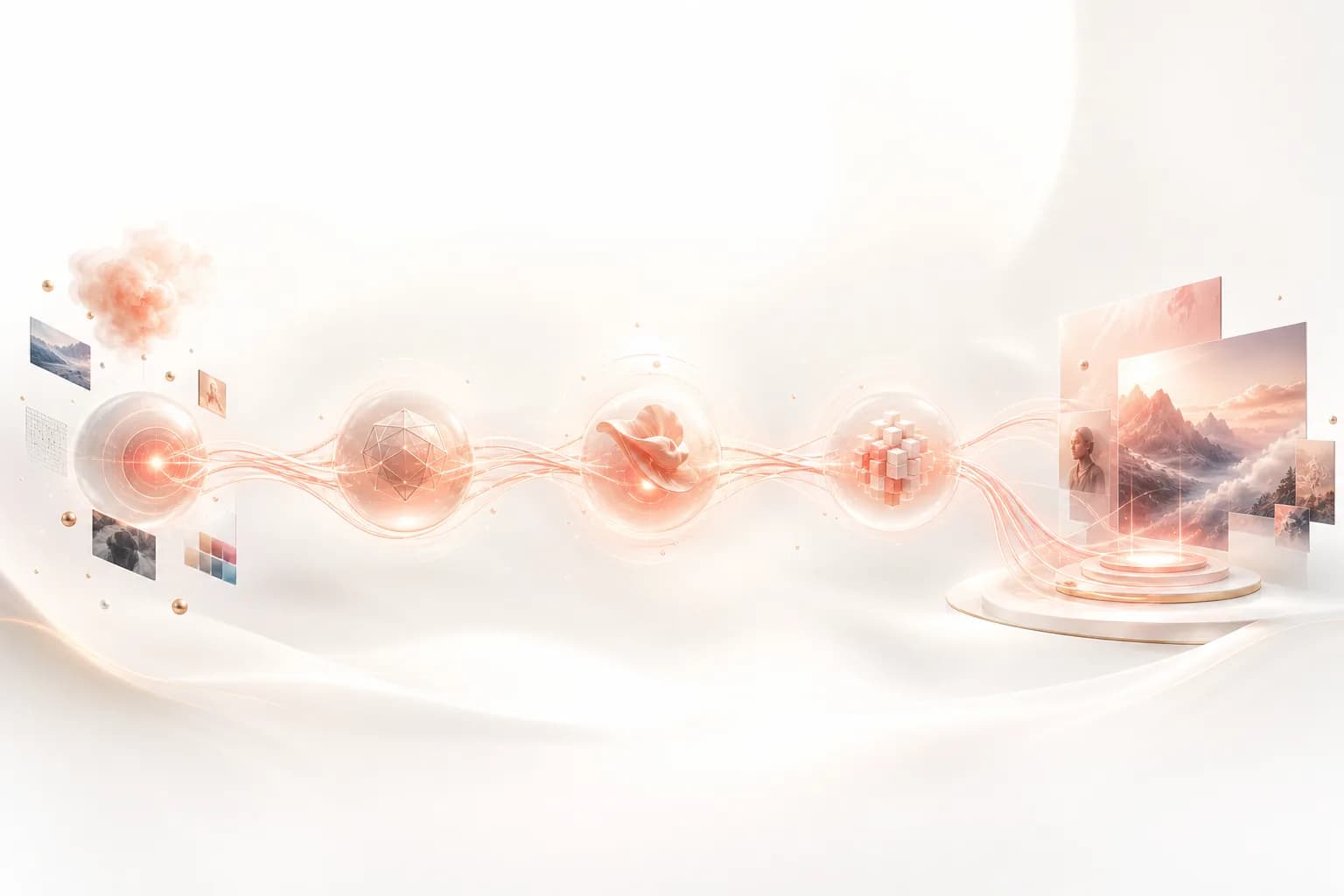
A talking avatar — a photo-realistic or stylized digital presenter synced to a voice track — is one of the most high-value AI production outputs for corporate video, e-learning, marketing, and social content. Building a robust talking-avatar workflow in Floniks means combining portrait generation, lip-sync processing, voice synthesis, and background compositing into a single automated pipeline. This guide covers every step: generating or uploading the avatar portrait, synthesizing the voice track, running lip-sync, compositing the avatar against a virtual background, and adding captions. You will finish with a reusable template that produces broadcast-quality talking-avatar videos for any script in one workflow run.
What a Talking-Avatar Workflow Produces
A talking-avatar workflow takes a script as input and produces a finished video of a digital presenter reading that script aloud — complete with synchronized lip movements, natural facial micro-expressions, a chosen background environment, and optional caption subtitles. The output is indistinguishable in production value from a video recorded with a real presenter in a professional studio, at a fraction of the time and cost.
Use cases span a wide range: corporate training modules where a consistent branded presenter delivers content across a curriculum; marketing explainer videos where a product spokesperson presents features in multiple languages without re-recording sessions; social media content where the avatar maintains a consistent persona across dozens of short clips; and e-learning courses where an instructional avatar guides learners through exercises. The talking-avatar workflow is particularly valuable when the script changes frequently — updating a training video or localizing a product video means only updating the script input and re-running the workflow, without re-booking talent or a recording studio.
The Floniks implementation chains three core AI modules: a voice synthesis module (text-to-speech with voice cloning), a lip-sync module (driving the avatar portrait with the audio), and an optional background compositing module (replacing the portrait background with a virtual environment). Each module is a separate node in the /editor canvas, allowing you to swap or upgrade any component independently without rebuilding the whole pipeline.
Generating or Selecting the Avatar Portrait
The avatar portrait is the foundation of the entire workflow — every other module operates on this image. You have two options: upload a real photograph of a presenter, or generate a synthetic portrait using the AI Image node. For most use cases, a generated portrait offers advantages: no talent rights issues, freely adjustable appearance (age, gender, ethnicity, attire), and the ability to generate a "brand-consistent" presenter whose appearance matches your visual identity guidelines.
To generate a high-quality presenter portrait, use the Text-to-Image node with a prompt structure like: "professional headshot, [gender] in [age range], [ethnicity], [attire: business professional / casual / branded uniform], direct eye contact, neutral expression with slight approachable smile, soft studio lighting, shallow depth of field, clean white or gradient background, photorealistic, 8K, sharp focus." Adjust these parameters to match the persona you are building.
After generating the portrait, run it through a Face Enhancement node to ensure the eyes are sharp, the skin texture is natural (not over-smoothed), and the facial proportions are anatomically correct. The lip-sync module performs best when the portrait has clearly defined lip boundaries, evenly lit face, and front-facing head orientation within ±15 degrees. Portraits with extreme three-quarter angles, face obscured by hair or beard, or strong directional shadow across the mouth region all reduce lip-sync quality significantly.
Synthesizing the Voice Track
The voice synthesis node takes the script text and produces an audio file at the natural reading pace of the chosen voice. Floniks connects to speech synthesis models that offer a range of voice presets — professional male and female English voices, various regional accents, and additional language voices. For brand-specific productions, a voice cloning option allows you to create a custom voice model from a sample recording, so the avatar speaks with a consistent voice identity across all content.
Write the script in the Voice Input node as natural spoken prose rather than formal written prose. Spoken language is shorter and simpler: contractions ("it's," "you'll," "we've") sound more natural than the full forms ("it is," "you will," "we have"). Sentences should be no more than 25–30 words. Reading pace is typically 130–150 words per minute for instructional content and 160–180 words per minute for marketing or sales content — set this in the synthesis speed parameter to match the intended use.
After synthesis, the audio node outputs an audio file and a word-level timing file that maps each word to a precise timestamp. This timing file is fed to the lip-sync node as a synchronization reference, allowing the lip movements to align precisely with the speech even at natural speech rhythm variations (pauses, emphasis, phrasing). Without the word-level timing file, the lip-sync module can only use envelope-based synchronization, which produces acceptable results but misses word-boundary precision.
Running the Lip-Sync Module
The lip-sync node drives the avatar portrait with the synthesized audio to produce an animated video. It takes three inputs: the portrait image, the audio file, and optionally the word-level timing file. The node outputs a video file with the portrait animated to match the speech, including lip movements, subtle jaw motion, eye blink patterns, and minor head micro-movements that prevent the avatar from appearing robotically static.
Lip-sync quality depends heavily on portrait preparation quality. The most common failure modes are: (1) blurred or low-resolution mouth region — the model cannot correctly infer the lip boundary, producing smeared transitions; (2) heavy beard or mustache obscuring the lip area — the model falls back to jaw-only motion, which looks unnatural; (3) strong side-lighting that casts deep shadow across the mouth — the model misreads the shadow as lip shape. For all three cases, apply portrait touch-up in the Face Enhancement node before the lip-sync pass.
For longer scripts (over 60 seconds), use the chunked processing mode: split the script into 20–30 second segments, process each segment independently, then concatenate the output clips. This prevents context drift in facial expression over long sequences and allows you to re-run only a specific segment if a lip-sync error occurs in one part of the script without re-processing the entire video.
Background Compositing and Caption Generation
After lip-sync, the avatar appears on the original portrait background (either the studio background from the photograph or the AI-generated backdrop from the portrait node). For most productions, you will want to replace this with a branded environment: a corporate office, a clean gradient background matching brand colors, an outdoor location, or a virtual studio set. Connect a Background Replacement node after the lip-sync output. This node uses portrait matting to cleanly separate the avatar from the original background and composites it onto the new background with natural shadow and edge blending.
For virtual environments, use a looping or animated background clip rather than a static image — even a subtle depth-of-field bokeh animation on the background prevents the final video from feeling flat. A slow 2–3 second looping animation at low contrast is standard production practice.
Caption generation reads the word-level timing file from the voice synthesis node and renders synchronized subtitles on the video output. Configure the caption style — font, size, color, background, and positioning — in the Caption Styling node. For social media content, style the captions for viewing without sound (high-contrast white text, black shadow, 40pt minimum font size at 1080p). For e-learning, use centered subtitles below the avatar frame in the standard closed-caption format. Connect the caption node as the final step before the Output Collector to produce a single video file with burned-in or embedded subtitles depending on the delivery format.
Step by step
- 1
Generate the avatar portrait
In /editor, add a Text-to-Image node. Use a prompt like "professional headshot, business attire, direct eye contact, neutral approachable expression, soft studio lighting, clean white background, photorealistic." Run the generation and optionally connect a Face Enhancement node to sharpen the eye and lip regions. Save the output as the avatar portrait image.
- 2
Configure the Voice Synthesis node
Add a Voice Synthesis node. Paste your script text into the input field. Select a voice preset or upload a voice sample for cloning. Set reading pace to 140 words per minute for instructional content or 170 words per minute for marketing. Enable "word-level timing export" so the output includes the synchronization file for precise lip-sync alignment.
- 3
Connect the Lip-Sync node
Add a Lip-Sync node and connect three inputs: the portrait image from step 1, the audio file from step 2, and the word-level timing file from step 2. Set animation style to "subtle — professional" (minimizes exaggerated expressions for business content) or "expressive" for entertainment content. Set output video resolution to 1080x1080 (square) or 1920x1080 (widescreen) depending on distribution format.
- 4
Add Background Replacement
Connect a Background Replacement node after the Lip-Sync output. Upload your background image or video clip (a looping office environment, branded gradient, or virtual studio set). Set edge feathering to 8px and shadow synthesis to "enabled" so the avatar casts a subtle shadow on the new background. Review the seam quality around the hair and shoulders.
- 5
Generate captions and export
Connect a Caption Generation node using the word-level timing file from step 2. Style the captions: white text, black 2px shadow, 40pt at 1080p, positioned at 80% vertical position. Connect the output to an Output Collector node. Run the full workflow and download the finished video. Save the workflow as a template named "Talking Avatar — [Presenter Name]" for future script updates.
FAQ
How long a script can the talking-avatar workflow process in one run?+
For best quality, process scripts up to 60 seconds in a single run. For longer scripts, use the chunked processing mode: split the script into 20–30 second segments, process each independently, then concatenate the output clips using a video join node. This prevents expression drift over long sequences and allows targeted re-processing of any segment with lip-sync errors without re-running the entire script.
Can I use a real photograph of a person as the avatar portrait?+
Yes. Upload the photograph to the Image Input node instead of generating a portrait. Ensure you have the right to use the person's likeness for the intended purpose. Portrait quality requirements are the same: front-facing within ±15 degrees, sharp focus on the mouth region, even facial lighting without heavy shadows across the lip area. Run the photograph through the Face Enhancement node before the lip-sync pass to maximize synchronization quality.
Related guides
Build it on Floniks
Image, video, digital humans, and reusable workflows on one canvas. No card required.
Explore Floniks