
The Anatomy of a Strong AI Image Prompt
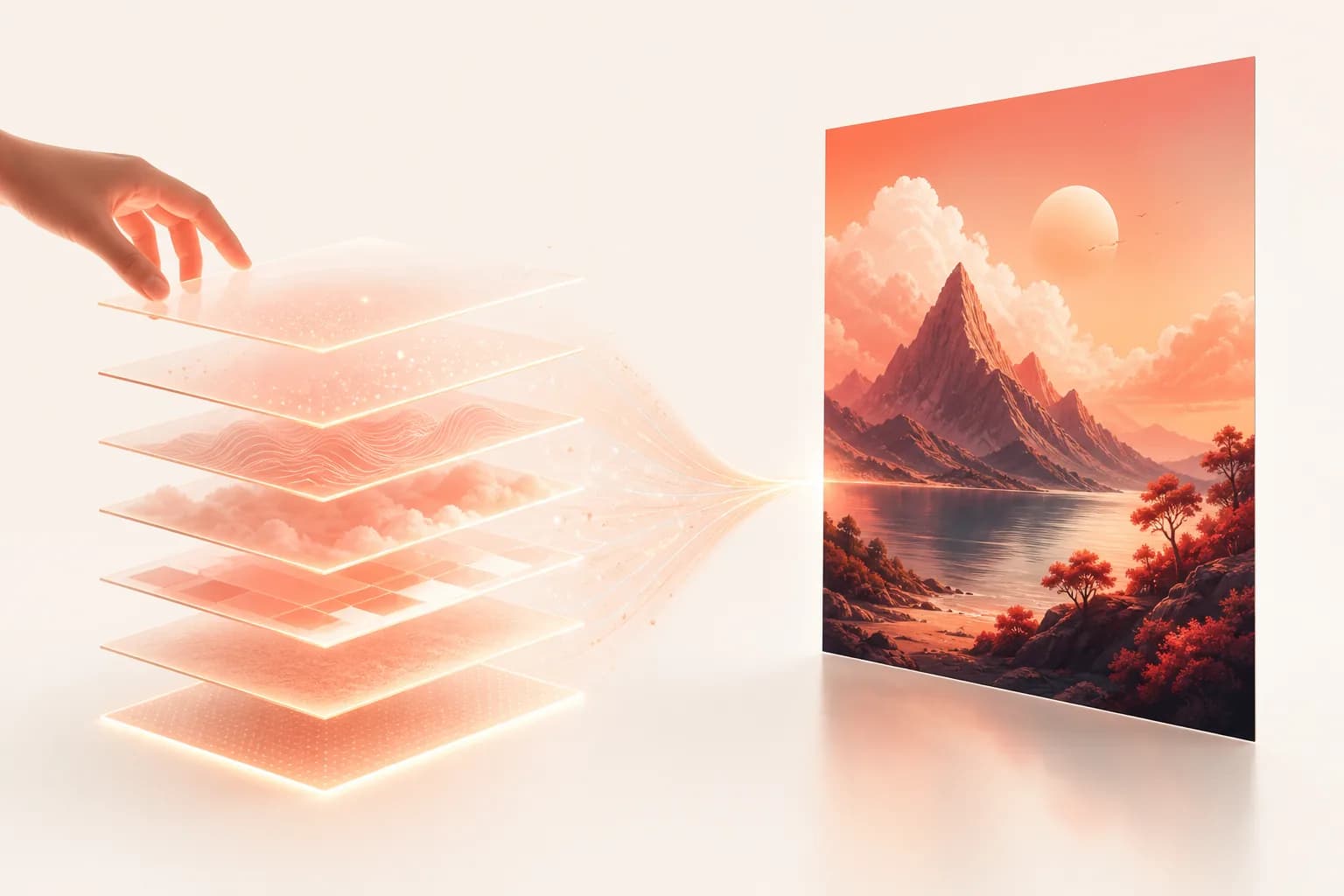
A strong AI image prompt is built from distinct layers rather than one run-on sentence: subject, composition, lighting, lens and camera, mood, art style, and technical parameters. Naming each layer explicitly gives the model fewer blanks to fill randomly, so results match your intent and stay repeatable across sessions. This guide dissects every layer with concrete phrasing you can copy and remix, explains which layers matter most for different creative goals, and shows how layered prompts slot naturally into a reusable Floniks workflow.
Why structure beats a run-on sentence
Most weak prompts fail not because the language is wrong, but because they describe only one dimension of the image — usually the subject — and leave everything else to chance. A model filling in blanks at random will give you inconsistent framing, arbitrary lighting, and an aesthetic that drifts from generation to generation. Structure fixes this. When you break a prompt into explicit layers, you hand the model a complete creative brief instead of a single sentence. Think of it like commissioning a photographer: you wouldn’t say "take a photo of a woman" and expect a masterpiece. You’d specify the location, the light source, the lens, the mood, the wardrobe. AI models respond the same way. Structure also makes iteration cheap — you can swap one layer (change the lighting from "soft golden hour" to "harsh midday sun") without rewriting the entire prompt, and the rest of the image stays stable. On Floniks, structured prompts are especially powerful because you can save them as workflow templates in /editor and reuse them across a whole product catalog or content series.
Layer 1 — Subject: the non-negotiable core
The subject layer answers: who or what is this image about? Be specific about identity, pose, expression, clothing, and any props. Vague: "a woman in a cafe." Strong: "a 30-year-old South Asian woman with short natural hair, wearing an oversized linen blazer, sitting at a marble cafe table, holding a ceramic espresso cup in both hands, looking slightly down at the cup with a small, private smile." Every detail you add is a blank the model doesn’t fill randomly. For products, name the exact object: "a minimalist matte-black ceramic mug, logo centered on the front, handle pointing right." For characters you plan to reuse across many images, store the subject description in a Floniks workflow node as a fixed input — this is the foundation of character consistency. If your subject includes multiple people, number them and describe each one separately: "Subject 1: … Subject 2: …" to avoid the model blending their features.
Layer 2 — Composition and framing
Composition tells the model how to arrange the subject in the frame. Without it, you’ll get centered, safe, portrait-orientation results every time. Useful composition phrases include shot distance (close-up, medium shot, wide establishing shot), angle (eye-level, low-angle, bird’s-eye view, Dutch tilt), and compositional rules (rule of thirds, leading lines, negative space on the left). A full composition layer might read: "medium shot, slightly low camera angle, subject positioned on the right third of the frame, generous negative space to the left filled with soft bokeh." Combining shot type with angle unlocks a huge range of visual grammar — the same subject photographed from a low angle feels powerful and heroic; from a high angle it feels vulnerable or small. The /learn/cinematography pillar covers shot types and angles in depth if you want to build fluency with these terms. The key rule: name your composition before you name your lighting, because composition shapes how light falls across the frame.
Layer 3 — Lighting: the mood multiplier
Lighting is the single layer that most dramatically changes the emotional register of an image without touching the subject. "Soft natural window light" and "dramatic chiaroscuro single-source light" can describe the same woman in the same cafe and produce images that feel like completely different genres. At minimum, name the light source (window, sun, LED panel, candle, neon sign), the quality (soft/diffused vs. hard/direct), the direction (front-lit, side-lit, back-lit, rim-lit), and the color temperature (warm golden, cool blue-white, neutral). A concrete lighting layer: "side-lit by a single large soft box to camera-left, warm 4500K color temperature, soft shadow falling across the right side of the face, gentle rim light on the hair." For product shots, lighting is arguably more important than subject description — the same mug looks premium under "soft flat diffused light with subtle gradient background" and cheap under harsh overhead light. See the full lighting vocabulary article in this pillar for a reference list you can copy into any prompt.
Layer 4 — Style, medium, and art direction
The style layer tells the model what visual tradition to draw from. This is where you specify photographic realism vs. illustration vs. painterly, and name the aesthetic movement or reference. Examples: "editorial fashion photography, shot on medium format film, Vogue aesthetic," or "cinematic digital still, muted earth tones, A24 film color grading," or "flat vector illustration, pastel palette, Scandinavian minimalist design." When targeting a specific art movement, name it precisely: "impressionist oil painting" gives the model far more signal than "artistic." You can also reference camera and film types for a photographic look: "Kodak Portra 400 film stock, slight grain, warm lifted shadows." For AI video on Floniks /ai-video, the equivalent layer is specifying the visual language of the clip — cinematic, documentary, animated — before you describe the action.
Layer 5 — Technical parameters and quality signals
Technical parameters communicate the desired output fidelity and format. Common signals include resolution intent ("8K detail," "ultra-sharp"), depth of field ("f/1.8 shallow depth of field, subject sharp, background creamy bokeh"), lens characteristics ("85mm portrait lens, slight lens compression"), and render quality ("hyperrealistic, photorealistic, octane render, ray-traced lighting"). You can also specify aspect ratio intent in the prompt itself if the model accepts text-based ratio hints, though Floniks' generation panels have dedicated aspect ratio controls that override or complement this. For product photography, add "no watermark, clean background, studio quality, commercial grade" to signal the output class. For artistic images, "painterly brushwork, visible texture, museum quality" steers toward fine-art rendering. Keep technical layer terms at the end of your prompt so they refine rather than compete with the subject and composition layers.
Putting it all together: a worked example
Here’s how the five layers combine into a single production-ready prompt:
Subject: "30-year-old Japanese woman with straight black hair, wearing a structured ivory blazer and minimal gold jewelry, holding a small bouquet of white peonies, neutral expression, direct eye contact with camera"
Composition: "medium portrait shot, eye-level, centered framing with slight headroom, clean background"
Lighting: "soft beauty dish front light with a subtle warm fill from camera-right, 5000K neutral daylight, catchlights visible in both eyes, no harsh shadows"
Style: "high-end editorial fashion photography, shot on Hasselblad medium format, clean and modern aesthetic"
Technical: "f/2.8 shallow depth of field, razor-sharp focus on eyes, background softly blurred, commercial studio quality"
Combined: 30-year-old Japanese woman with straight black hair, wearing a structured ivory blazer and minimal gold jewelry, holding a small bouquet of white peonies, neutral expression, direct eye contact with camera. Medium portrait shot, eye-level, centered framing. Soft beauty dish front light, subtle warm fill from camera-right, 5000K neutral daylight, catchlights in both eyes. High-end editorial fashion photography, Hasselblad medium format. f/2.8 shallow depth of field, commercial studio quality.
This prompt is roughly 90 words — long enough to be specific, short enough to stay coherent. Save it as a Floniks workflow template and swap the subject layer to generate a whole lookbook in one batch.
Step by step
- 1
Write your subject layer first
Describe who or what is in the image with identity, pose, expression, clothing, and props. Be as specific as you would be briefing a photographer.
- 2
Add composition and framing
Choose a shot distance (close-up, medium, wide), camera angle, and compositional placement (rule of thirds, centered, negative space direction).
- 3
Specify your lighting
Name the light source, quality (soft/hard), direction (front/side/back/rim), and color temperature. This single layer changes the emotional register of the image more than any other.
- 4
Name the visual style and medium
Reference the photographic or artistic tradition: film stock, art movement, camera brand, or genre aesthetic.
- 5
Close with technical parameters
Add depth of field, lens type, resolution intent, and quality signals at the end so they refine without overriding the core layers.
FAQ
How long should an AI image prompt be?+
Long enough to name each layer once. That typically lands between 60 and 120 words. Shorter prompts leave too many blanks for the model to fill randomly; longer ones can cause the model to lose track of earlier details. If you need to describe a very complex scene, break it into a multi-step Floniks workflow where each node handles one element.
Do I need every layer in every prompt?+
No — start with subject, composition, and lighting. These three layers eliminate the most variance. Style and technical parameters are refinements you add once the core image looks right.
Does the order of layers matter?+
Yes, roughly. Put the most important information first (subject, then composition) because models weight earlier tokens more heavily. Technical quality signals work best at the end as finishing instructions rather than competing with the core description.
Related guides
Build it on Floniks
Image, video, digital humans, and reusable workflows on one canvas. No card required.
Explore Floniks