
Prompting Backgrounds and Environments
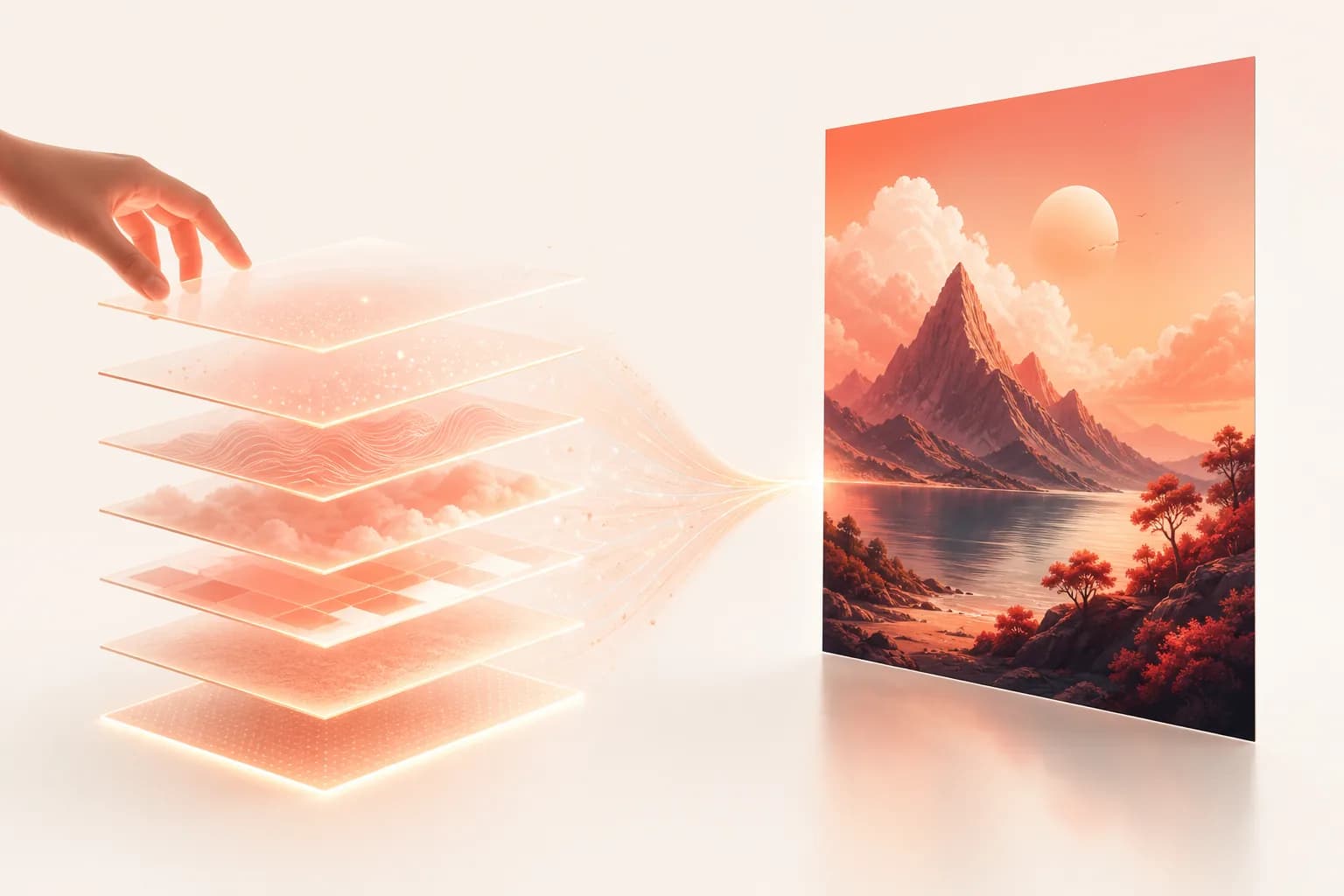
Backgrounds and environments are not passive containers — they define the tonal register, spatial depth, and narrative context of every image you create. A poorly described environment lets the model fill the frame with generic assumptions that undermine even a perfectly specified subject. This guide teaches you a layered vocabulary system for describing environments: from macro-scale setting and time of day down to surface materials, atmospheric depth, and peripheral detail. Whether you need a stark product studio, a moody urban canyon, or an expansive natural landscape, applying these techniques in Floniks will produce backgrounds that actively strengthen your subject rather than compete with it.
Why Environment Prompting Is More Than a Backdrop
The background of an image does far more visual work than simply filling empty space behind the subject. It establishes geographic and temporal context, contributes 40 to 60 percent of the image's overall color palette, defines the quality and direction of ambient light, and sets the viewer's emotional expectations before they even register the subject. When an AI model receives an under-specified environment prompt — "a person in a park" — it selects a generic average park from its training data, which typically means flat green grass, middle-distance trees, and overcast sky: visually inoffensive but deeply unremarkable. By contrast, "a woman on a bench in a rain-slicked Tokyo side street at blue hour, neon karaoke bar signs reflected in wet pavement, steam rising from a gutter grate" conjures an immediate, specific world. Every additional environment detail you provide is a constraint that steers the model away from the average and toward a distinctive, art-directed image.
The Four Depth Layers of an Environment
Professional art directors think about scenes in depth layers, and your prompts should too. The four standard layers are: foreground (the elements closest to the camera — often partially cropped or blurred, providing depth framing), midground (where the subject typically lives), background (the world behind the subject, providing environmental context), and sky or ceiling (the uppermost plane that defines ambient light quality). Describing each layer separately prevents the model from collapsing all environment detail into a single undifferentiated plane. A layered environment prompt might read: "wildflower meadow grasses in blurred foreground bokeh, woman standing in a sunlit clearing in midground, dense forest edge receding into atmospheric haze in background, pale golden overcast sky above." Each clause gives the model a distinct spatial assignment, and the resulting depth stack creates a three-dimensional scene rather than a flat theater backdrop.
Surface Materials and Ground Plane
The ground plane — what the subject or scene rests on — is one of the most overlooked environment elements in prompting, yet it dramatically affects perceived realism and atmosphere. "Standing on marble tile, wet reflections underfoot" reads differently than "standing on cracked concrete sidewalk with gum stains and a storm drain grate." Material specificity cascades into light behavior: marble reflects specularly, wet asphalt creates diffuse mirror reflections, dry sand absorbs light and scatters it into ambient fill, polished wood planks create warm-toned directional reflections. Specify the material, its condition (worn, polished, wet, dusty, cracked), and its reflective properties. Wall and ceiling materials follow the same logic: "exposed brick wall with faded mural," "raw concrete ceiling with industrial pendant lights," "white plaster wall catching late afternoon window light." These surface descriptions give the model enough physics context to simulate plausible light interaction across the environment.
Atmospheric Depth and Environmental Haze
Atmospheric perspective — the phenomenon where distant objects appear lighter, cooler in hue, and lower in contrast due to air particles — is one of the most powerful tools for making environments feel genuinely three-dimensional. Prompt for it explicitly: "atmospheric haze fading background to pale blue-grey," "volumetric mist at mid-distance," "golden dust particles in foreground shafts of light," "fog rolling in from the sea, visibility reduced to 50 meters." Interior environments benefit from atmospheric cues too: "dust motes in a shaft of afternoon light," "incense smoke drifting across the room," "steam from a kettle softening the window light." These atmospheric elements do more for a sense of spatial depth than any compositional rule, because they simulate the actual physics of light traveling through a medium. In Floniks, combining these cues with the mood and style keywords of your chosen visual register produces immersive environments at every scale.
Studio and Controlled Environments
Not every environment is natural or architectural. Controlled studio environments — seamless backgrounds, cycloramas, light tent setups — are essential for product photography, portraiture, and any imagery that needs to be isolated from narrative context. For seamless studio: "seamless white paper background, even studio lighting, no shadows," "light grey seamless cyclorama, commercial photography," "infinity curve background, gradient from white floor to off-white wall." For product light tent: "suspended product on glass shelf, backlit light tent, pure white environment, no reflections from walls." Color seamless backgrounds follow the same pattern: "deep midnight blue seamless background, studio strobe from camera left." For lifestyle-in-studio — the hybrid of controlled background with natural-feeling subject interaction — try: "mid-grey seamless background, natural window light simulation from frame right, lifestyle portrait, no props competing with subject." Floniks' /ai-image tool handles these controlled environment prompts cleanly, producing consistent product-ready outputs across multiple SKUs when used in a batch workflow.
Cultural and Architectural Environment Vocabulary
Architectural and cultural setting vocabulary carries enormous implied visual information. "Izakaya interior, Tokyo" immediately implies paper lanterns, wooden booths, smoke, izakaya menu boards, warm amber light, and narrow passage between tables — none of which you need to specify individually. "19th-century Parisian haussmanian apartment" implies parquet floors, tall casement windows with iron balconies, ornate plaster molding, and natural north light. "Detroit mid-century factory floor, decommissioned" implies concrete, rust, broken skylights, graffiti, and dust. Naming the cultural and architectural type precisely activates these associated visual packages efficiently. Then refine the generic image with one or two specific corrective details: "Tokyo izakaya but unusually empty, single customer at the counter, late closing hour" adds narrative specificity that transforms the generic cultural setting into a particular moment.
Building a Background Library for Consistent Work
In production contexts — social media campaigns, product photography series, character scene sets — background consistency across multiple images is essential. The most efficient approach is to build a background prompt library in Floniks' reusable template system. Write a base environment prompt for each setting you use regularly: studio white, urban exterior, interior café, natural forest, etc. Store each as a named template fragment that can be inserted into any new prompt as a starting block. Pair each environment template with a fixed seed to reproduce the general spatial layout reliably across sessions. When you need variation within a consistent world — same city street, different weather — modify only the atmospheric layer of the template, keeping the architectural and material layers constant. This library approach transforms environment prompting from a blank-page creative task into a structured content production system, saving time and ensuring visual cohesion across large content batches in the Floniks workflow editor.
Step by step
- 1
Describe the scene in four depth layers
Write separate prompt clauses for foreground, midground, background, and sky/ceiling. This prevents the model from collapsing all environment detail into one plane and creates natural spatial depth.
- 2
Specify ground plane material and condition
Name the floor material and its state — wet marble, cracked asphalt, polished hardwood, dry sand — to give the model a physics anchor for light reflections and spatial grounding.
- 3
Add an atmospheric depth cue
Include one atmospheric element — haze, mist, dust motes, smoke, or fog — at a specific distance. This simulates real-world aerial perspective and makes the environment feel genuinely three-dimensional.
- 4
Save environment prompts as reusable templates
In Floniks' template library, store your best-performing background prompts as named fragments so they can be attached to any subject prompt in seconds, ensuring visual consistency across a production batch.
FAQ
Should the background prompt come before or after the subject description?+
Subject description should come first in the prompt, as early tokens carry more weight. Once the subject is anchored, environment details follow. This ensures the model treats the environment as context for the subject rather than the primary focus of the generation.
How do I stop the background from distracting from my subject?+
Use depth-of-field language to push the background into blur: "background in soft bokeh," "shallow depth of field, background defocused." Reducing background detail density in the prompt — fewer nouns, less specificity — also reduces the model's tendency to over-render the environment at the subject's expense.
Can I use environment prompts effectively in AI video on Floniks?+
Yes. Environment vocabulary works in video prompts and also conditions motion behavior — a windy coastal cliff implies moving grass and water; a subway car implies vibration and passing lights. Including specific environment detail in your video prompts at /ai-video produces more immersive, contextually plausible motion.
Related guides
Build it on Floniks
Image, video, digital humans, and reusable workflows on one canvas. No card required.
Explore Floniks