
Prompting Abstract and Generative Art
Abstract and generative art represents the frontier where AI image generation escapes the constraints of photographic representation and enters a space of pure visual language — color, form, texture, rhythm, and spatial tension working without the anchor of recognizable subject matter. Paradoxically, generating compelling abstract art requires more conceptual clarity than figurative prompting, because there is no subject to fall back on. This guide covers the vocabulary for mathematical and algorithmic aesthetics, color field and gesture abstraction, texture exploration, motion and energy systems, and how to describe compositional tension without referencing any real-world objects — skills that unlock a dimension of AI generation that most users never access.
The Abstract Prompting Paradox: More Concept, Less Constraint
When generating representational imagery, the subject anchors the model's choices — the architecture of a face, the physics of a landscape, the conventions of a product shot. Remove the subject, and those anchors vanish. The model now has near-infinite degrees of freedom in form, color, texture, and composition. Without direction, it defaults to one of a handful of heavily trained abstract aesthetics: colorful splatter on black, rainbow gradient fluid, fractal zoom, or generic 'digital art' patterns. These defaults appear with high frequency in AI abstract generation precisely because they are statistically dominant in the training data. To escape these defaults, your abstract prompts need to supply conceptual constraints that replace the missing subject anchor. Instead of describing what is in the image, describe the visual experience you want the viewer to have, the structural principles governing the composition, and the specific visual traditions you are drawing from. 'A sense of barely contained energy on the verge of explosion, horizontally compressed compositional tension, high-contrast hard-edge geometry in collision, limited palette of burnt orange and deep indigo' supplies enough structural direction to produce something specific. The contrast with 'abstract art, colorful' illustrates the difference between providing conceptual constraints and providing no constraints at all. Abstract prompting is harder than figurative prompting precisely because it demands genuine aesthetic intention rather than description of a known subject.
Mathematical and Algorithmic Aesthetics
Some of the richest territory in abstract and generative AI art is the simulation of computational and mathematical visual systems. These aesthetics have strong training precedents in both traditional generative art (Vera Molnar, Casey Reas, Sol LeWitt) and contemporary creative coding, giving models reliable knowledge to draw from. Cellular automata and emergent pattern: 'Conway Game of Life-style emergent pattern, complex self-organizing structure arising from simple local rules, high-contrast black and white cell grid, visible local rule repetition producing global complexity.' Reaction-diffusion systems: 'Turing pattern reaction-diffusion system, organic striped and spotted pattern similar to animal skin markings, slow wavelength structure with high-frequency detail, grey-scale biological patterning quality.' Fractals and self-similarity: 'Mandelbrot set fractal zoom, deep iteration count revealing fine structure, color cycling at each iteration depth, infinite self-similar complexity.' Voronoi diagrams: 'Voronoi tessellation, organic irregular cell structure, each cell a distinct soft color, dark boundary lines between cells, biological tissue cross-section quality.' Flow fields: 'particle flow field visualization, thousands of individual particles following a mathematical vector field, streaming paths revealing the underlying field structure, long exposure accumulation quality, dark background.' Lissajous curves: 'Lissajous curve parametric drawing, complex intersection of two sinusoidal motions, clean glowing line on black background, frequency ratio producing tight geometric petals.' Each of these mathematical systems has a distinctive visual character that the model can generate accurately when named directly.
Color Field and Gestural Abstraction Traditions
Abstract painting has rich art historical traditions that AI models have absorbed, enabling direct vocabulary references that produce specific aesthetic outcomes. Mark Rothko's color field painting: 'color field painting in the tradition of Rothko, two or three large luminous color rectangles floating on a slightly different color ground, soft hazy edges where one field meets another, deep emotional resonance in the color relationships, large scale implied, museum quality.' Franz Kline calligraphic abstraction: 'bold gestural calligraphic brushstroke abstraction, thick black marks on white field, confident single-motion strokes of varying width, implied speed of execution, energy visible in the gesture quality.' De Kooning-style action painting: 'energetic action painting, loose aggressive brushwork, color mixing and dragging on the canvas surface, multiple directions of gesture visible, psychological urgency, expressive mark-making.' Minimalist hard-edge abstraction: 'hard-edge abstraction, clean geometric forms with absolutely sharp boundaries between color fields, no visible brushwork or texture, flat color planes, precise and deliberate compositional tension between form and ground.' Color interaction (Albers): 'Josef Albers color interaction study, same color appearing different against different surrounding colors, optical illusion of color change produced by juxtaposition, pedagogical clarity of color theory demonstration.' Tapies texture field: 'textured abstract painting, thick impasto surface with embedded materials, scratched and incised marks revealing layers beneath, archaeological quality surface, earth tone palette.' Invoking these traditions gives you immediate access to their entire vocabulary of compositional, textural, and chromatic strategies.
Texture, Surface, and Material in Abstract Art
In the absence of a recognizable subject, texture becomes the primary sensory experience of an abstract image. The texture of a painted surface — the drag of a palette knife, the splatter of a loaded brush, the smooth pour of acrylic fluid — carries enormous emotional and physical weight that purely digital smooth abstraction lacks. Prompting for specific surface qualities produces abstract images with tactile presence. Impasto and thick paint: 'thick impasto oil painting texture, visible palette knife tracks and ridges, peaks of paint casting small shadows, physicality of material substance, tactile surface quality.' Paint drips and flow: 'drip painting in the tradition of action painting, multiple poured streams of different viscosity paint flowing and intersecting on a horizontal surface, freeze-frame of the flow process.' Encaustic wax surface: 'encaustic wax abstract, translucent layered hot wax surface with embedded pigment, depth visible through the wax layers, ancient material quality, scratched and burnished marks.' Monotype print texture: 'gestural monotype print texture, ink transferred with visible uneven pressure, ghost impression quality, ink pooling and thinning, printmaking surface character.' Collage fragments: 'abstract collage, fragments of torn paper at various angles, visible paper edges and glue texture, layered fragments creating depth through overlapping, mixed media surface.' Paper marbling: 'paper marbling pattern, swirled paint on water surface combed into flowing patterns, transferred to paper ground, organic and symmetric simultaneously, rich color interactions in the marbled surface.' Specifying the physical material tradition rather than 'abstract texture' gives the model far more specific guidance toward a genuine tactile surface quality.
Composing Abstract Space and Compositional Tension
Abstract composition without a subject requires explicit compositional direction to avoid a visually inert, symmetrical, or visually static result. The principles of compositional tension — the sense that forces in the image are in dynamic relationship rather than passive coexistence — are as essential in abstract work as in figurative photography. Asymmetric weight: 'compositionally asymmetric, heavy dark mass in lower left opposed by lighter active zone in upper right, visual tension across the diagonal axis, off-center balance.' Spatial compression: 'deep spatial compression, elements pressing from all directions toward a central point of resistance, claustrophobic spatial tension, no comfortable resting place for the eye.' Expansive emptiness: 'vast empty field with single isolated mark, enormous negative space making the mark feel simultaneously tiny and significant, meditative and vast, scale ambiguity.' Edge-based tension: 'primary activity concentrated at and beyond the frame edges, the center of the composition relatively empty, viewer's attention pulled toward the margins as though the image continues invisibly beyond the frame.' Scale contrast: 'extreme scale contrast between very large and very small forms, neither scale feels comfortable or natural, uncanny spatial dissonance.' Color tension: 'simultaneous contrast between warm and cool, complementary color pair in near-equal proportion, visual vibration at the boundary where the two colors meet, eye unable to resolve which advances and which recedes.' These compositional tensions — rather than subject matter — are what make abstract images emotionally engaging rather than visually inert decorative pattern.
Generative Series and Variation Workflows
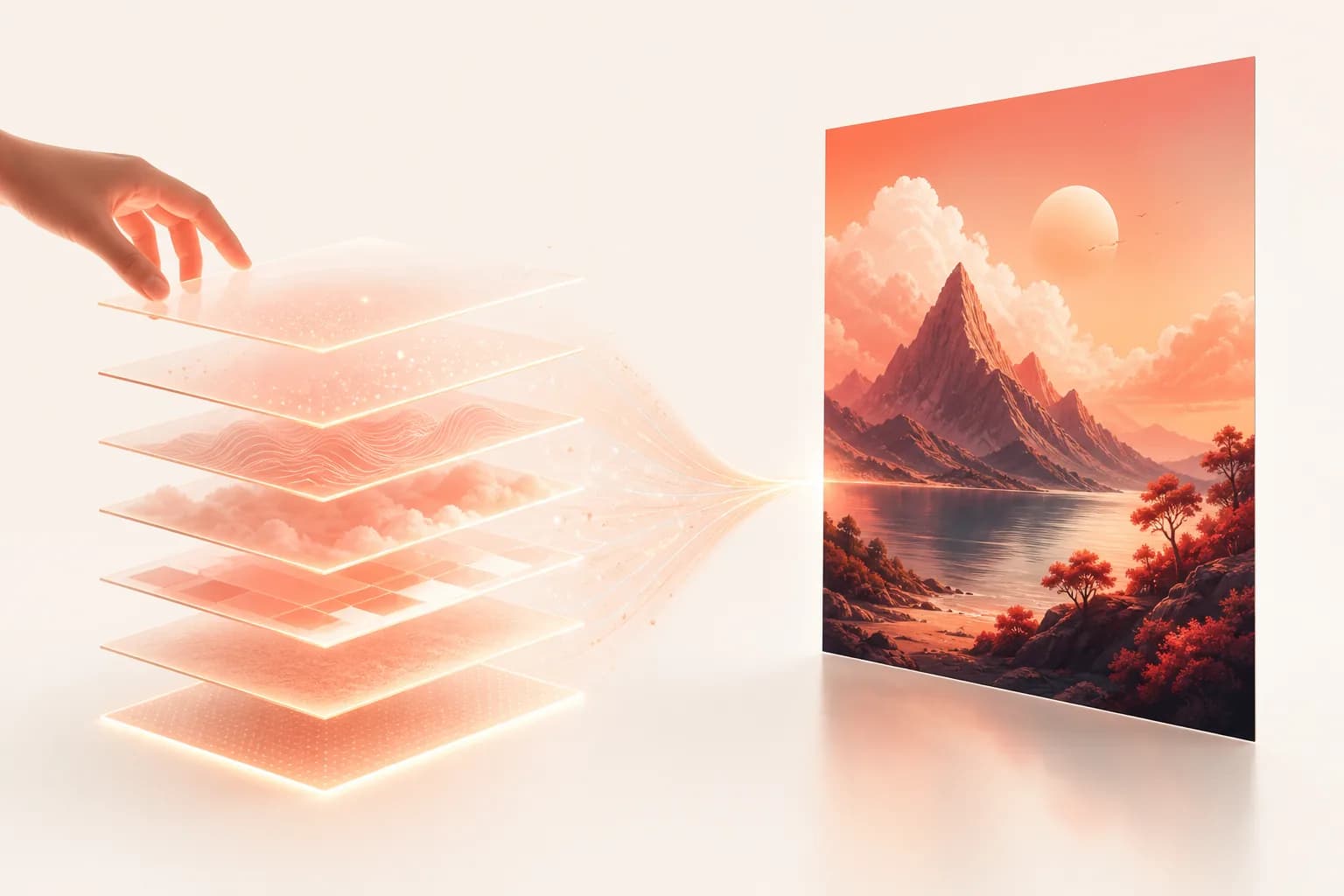
One of the unique capabilities of AI-generated abstract and generative art is the ability to produce large series of related variations that explore the parameter space of a visual system. Where a human artist might spend months exploring variations on a single compositional idea, a Floniks workflow can generate dozens of controlled variations in a single session. The key to meaningful variation is specifying which variables to change and which to hold constant. A coherent exploration holds the mathematical system and color palette constant while varying the specific parameters: 'Voronoi tessellation, consistent use of cool blue and warm amber palette throughout the series, vary only the cell density and boundary line weight across the variations.' Or hold the compositional structure and vary the color: 'same compositional structure of three color fields in lower-left, upper-right, and small central rectangle — generate twelve color variations using different color relationships: complementary, analogous, split-complementary, triadic, monochromatic.' In Floniks' workflow editor, build a series prefix node containing the invariant parameters and connect it to a variation node that samples across the target variable range. The result is a coherent exploration rather than a random collection of loosely related images. For artists developing an original abstract visual language, this kind of systematic variation is how you discover which combinations within your chosen parameter space produce the most compelling results — a process that would take weeks by hand and can be completed in hours through the workflow editor.
Step by step
- 1
Supply conceptual constraints to replace the missing subject anchor
For every abstract prompt, provide three conceptual parameters before any visual description: the emotional experience you want to produce, the structural principle governing the composition, and the visual tradition you are drawing from. These replace the subject anchor that figurative prompts rely on.
- 2
Reference specific mathematical systems or art historical traditions by name
Instead of describing abstract qualities, name the specific system: Voronoi, reaction-diffusion, Turing patterns, Lissajous curves, Rothko color field, Kline calligraphic gesture. These names carry complete visual vocabulary that would require paragraphs to describe from scratch.
- 3
Build variation workflows that hold some variables constant
Use Floniks' workflow editor to create series explorations that vary only one or two parameters while holding the rest constant. Specify which variables change (color palette, cell density, gesture direction) and which remain fixed (compositional structure, mathematical system, surface texture). This produces coherent explorations rather than random variation.
FAQ
How do I avoid the default 'rainbow splatter on black' result that AI models seem to default to for abstract art?+
This default appears because it is statistically dominant in the training data for 'abstract' prompts. Override it by naming a specific tradition ('hard-edge color field painting,' 'reaction-diffusion system,' 'Kline-style calligraphic abstraction') and specifying a limited color palette explicitly. The combination of a named tradition and a constrained palette eliminates the default averaging almost entirely.
Can I use AI-generated abstract art for commercial purposes?+
The commercial use rights for AI-generated images depend on your platform's terms of service. Floniks' outputs under its standard terms grant you usage rights for the images you generate. For art that references specific named artists, be aware that while style itself is not copyrightable, very close stylistic mimicry of living artists may raise ethical considerations even if not strictly legally restricted.
How do I create a coherent series of abstract works for a gallery or portfolio?+
Define the series parameters before generating: which single mathematical or aesthetic system does the series explore, what is the constrained color palette, what is the range of compositional variation. Build a Floniks workflow that holds the system and palette constant while sampling across the compositional variable. Generate twenty to thirty variations and curate the ten most compelling. A coherent series has a single clear investigation, not random variety.
Related guides
Build it on Floniks
Image, video, digital humans, and reusable workflows on one canvas. No card required.
Explore Floniks