
Prompting Isometric and 3D-Style Scenes
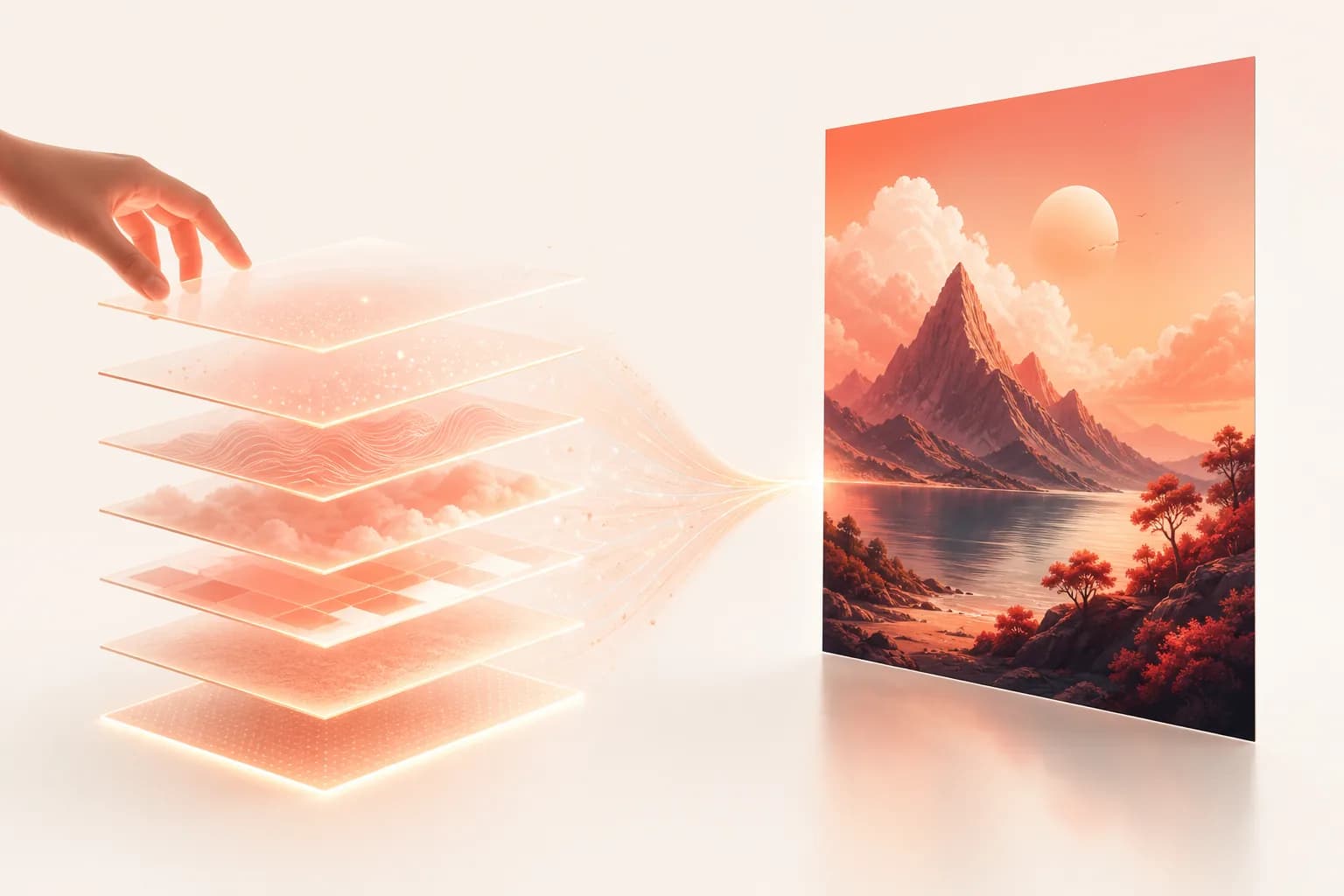
Isometric and 3D-style illustration has become a dominant visual language in tech branding, infographics, game art, and editorial design. But AI models frequently misinterpret isometric requests, producing perspective distortions or false 3D that violates the geometric rules that make the style distinctive. This guide teaches you the exact prompt architecture to reliably generate true isometric compositions, low-poly 3D environments, clay render aesthetics, and product-visualization 3D scenes. You will learn how to specify projection type, lighting direction, depth treatment, and object placement in language the model actually responds to — and how to chain outputs into a consistent Floniks workflow for production-scale 3D-style content.
Understanding Isometric Projection vs Perspective
Isometric projection is a specific drawing system in which three axes — X, Y, and Z — are drawn at equal 120-degree angles to each other, and objects maintain their true proportions regardless of distance from the viewer. Unlike one-point or two-point perspective, isometric drawings have no vanishing points: parallel lines remain parallel, and there is no convergence at a horizon. This distinction matters for prompting because AI models have been trained on enormous quantities of perspective photography and illustration. Without explicit projection type constraints, they default to perspective. To override this default, do not simply write 'isometric' — include the full projection specification: 'true isometric projection, 30-degree axonometric angles, no perspective distortion, parallel projection, no vanishing point.' Adding a camera angle reinforcement — 'viewed from above at 45 degrees on the diagonal, equal weighting on three visible faces' — further steers the model. The most common failure mode is an image that looks isometric at first glance but has subtle perspective convergence that makes objects at the back of the scene smaller than objects at the front. The explicit 'no perspective distortion' constraint significantly reduces this failure.
Isometric Scene Layout and Object Placement
Isometric compositions typically organize objects on a grid-aligned platform or floating tile, with a clear visual axis running from front to back. When prompting scene layout, describe the containing form first: 'isometric floating island platform, grass top with dirt underside, rectangular proportions,' or 'isometric office floor tile, grey carpet, three walls visible.' Then populate the scene with objects described relative to this base: 'small wooden desk at left-facing position on the platform, monitor and keyboard on desk surface, potted plant at the rear left corner, filing cabinet at the rear right corner.' Placing objects in the front-left, front-right, and rear-center positions of the isometric frame exploits the natural visual hierarchy of the projection — front-facing surfaces carry the most visual information, so the most important props belong there. Avoid placing highly detailed objects at the very rear of a complex scene, where the accumulated overlapping will create visual noise that the model struggles to resolve cleanly.
Lighting in Isometric and 3D-Style Scenes
Isometric illustration conventionally uses a fixed lighting direction that reveals all three visible faces of each object at different brightness values: the top face receives the most light (lightest value), one side face receives medium light, and the opposite side face is in shadow (darkest value). This three-value shading is what gives isometric objects their distinctive solid appearance. To prompt for it explicitly: 'isometric shading with three distinct face values — top face lit bright, left face mid-tone, right face in shadow' or 'consistent directional light from upper left, creating highlight on top and left faces, shadow on right face, hard-edged shadow cast on adjacent surfaces.' Soft lighting — ambient occlusion style, gradient-lit, multiple light sources — tends to undermine the crisp geometric clarity that makes isometric illustration recognizable. The prompt constraint 'hard-edged shadows, no gradient lighting, flat distinct face values' keeps the output in the clean illustrative register. For 3D product visualization that departs from pure isometric style, soft studio lighting is appropriate: 'soft box studio lighting from upper right, subtle AO in corners, product surface reflections, neutral grey gradient background.'
Low-Poly and Faceted 3D Style
Low-poly style presents 3D objects rendered with a reduced polygon count — visible triangular or polygonal faces instead of smooth curved surfaces. It is widely used in game art, environmental design, motion graphics, and a specific strain of contemporary illustration. To prompt accurately: 'low-poly 3D style, visible triangular polygon faces, faceted surfaces, no smooth shading, flat-shaded polygons with distinct color per face, jewel-like geometric quality.' Color treatment in low-poly is typically a warm-cool color scheme applied across the facets: 'each polygon face a slightly different hue variation of the base color, creating prismatic variation across the surface.' Common objects for low-poly treatment: 'low-poly mountain landscape, faceted terrain with triangular peaks, palette of teal, cerulean, and deep navy blue, simple pine tree silhouettes at foreground.' For animated low-poly content in Floniks' video pipeline, the faceted surface quality creates distinctive motion as polygons catch light at changing angles.
Clay Render and Toy-Like 3D Aesthetics
Clay render style — popularized by design presentation tools and a specific strand of contemporary 3D illustration — presents objects as if modeled in soft uniform-colored clay under studio lighting. The aesthetic is distinguished by: uniform matte pastel color with no texture maps, soft even studio lighting with ambient occlusion in recessed areas, rounded forms with subtle bevel on all edges, and a toylike miniature quality even at large scales. To prompt: 'clay render style, all surfaces uniform warm white matte clay, no texture, soft AO in corners and gaps, rounded bevel on all edges, studio lighting from above, pastel color accent on selected surfaces, miniature toy quality.' Color variations: 'pastel clay render, soft mint green and warm cream palette, subtle pink accent on one surface, no hard shadows, toy-store display aesthetic.' The clay render style is exceptionally effective for product concept visualization in Floniks — it makes early-stage design ideas look deliberate and art-directed without committing to the full detail of a photorealistic render.
Building Isometric Scene Sets with Floniks Workflows
Production-scale isometric content — an entire app icon set in isometric style, a series of explainer illustrations, a world-building asset library — requires systematic consistency that individual generations cannot guarantee. The Floniks workflow editor is the right tool for this. Build a base workflow with the isometric system spec — projection type, lighting direction, platform style, color palette, shading approach — as a locked prefix template. Branch the workflow into individual scene generation nodes, each appending its own scene content description to the locked base. All branches share the same system spec, ensuring that each output is visually coherent with every other. Route all outputs through a post-processing node that applies uniform background color or transparency, creating a set of images that can be assembled into a grid or animation sequence without per-image color correction. For teams producing isometric world-building content in volume, this workflow architecture turns a multi-day manual illustration brief into a sub-hour batch generation run.
Step by step
- 1
Specify the projection type explicitly
Write 'true isometric projection, 30-degree axonometric angles, no perspective distortion, parallel lines do not converge' in every isometric prompt. Do not rely on the word 'isometric' alone.
- 2
Describe three-value shading direction
State which face is lightest, which is mid-tone, and which is in shadow — for example, 'top face lit, left face mid-tone, right face shadowed.' This anchors the model to the standard isometric lighting convention.
- 3
Use clay render style for product concept visualization
For early-stage design presentations, prompt 'clay render, uniform matte surface, soft AO, rounded bevel edges' to produce clean concept-level 3D visuals without committing to full photorealistic detail.
- 4
Build a system spec template in Floniks for scene sets
Save the shared projection, lighting, and color spec as a locked template fragment. Apply it across all nodes in an isometric batch workflow to ensure visual system coherence without repetitive manual prompting.
FAQ
Why do my isometric prompts often come out looking like perspective drawings?+
AI models default to perspective because the vast majority of their training images use perspective projection. Counter this by explicitly writing 'no vanishing point, parallel projection, parallel lines stay parallel' alongside 'isometric' in your prompt. Reinforcing the constraint in multiple ways reduces the frequency of the perspective default significantly.
What is the best color palette approach for isometric illustration?+
Isometric illustration typically uses a limited palette of three to five colors, with each object assigned tints and shades of those colors rather than new colors. Specify the palette explicitly — 'soft teal, warm peach, off-white, and charcoal' — and add 'consistent palette applied across all objects in the scene, no additional colors introduced.' This keeps the set coherent.
Can I generate isometric animations in Floniks?+
Floniks can generate video from isometric-style image seeds via the image-to-video pipeline. Start by generating a clean isometric still, then pass it into the video node with a motion prompt: 'subtle camera pull-back revealing more of the scene, objects settling into place, no camera rotation.' Avoiding camera rotation preserves the isometric projection through the animation.
Related guides
Build it on Floniks
Image, video, digital humans, and reusable workflows on one canvas. No card required.
Explore Floniks