
Prompting Watercolor and Gouache Styles
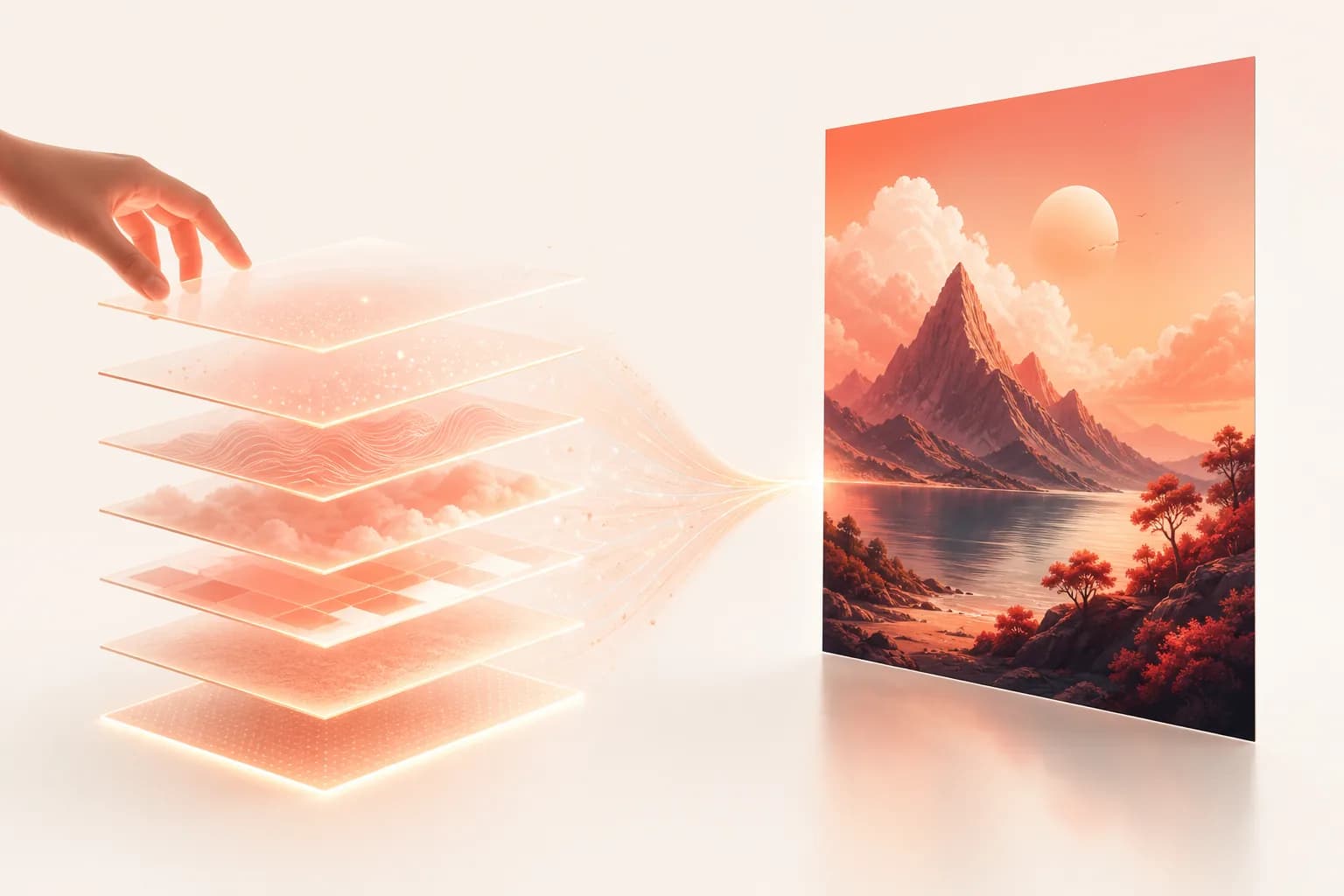
Watercolor and gouache occupy distinct aesthetic territories that AI models frequently conflate unless you supply precise medium-specific vocabulary. Watercolor is defined by transparency, wet-edge blooms, pigment pooling, and visible paper texture. Gouache is defined by opacity, flat graphic coverage, chalky highlights, and matte surface. Getting either style right means prompting the physical behavior of the medium — how paint moves through water, how it dries, what it does at edges — rather than simply naming it. This guide gives you the complete technical and aesthetic vocabulary for both media, with concrete prompt fragments you can apply directly in Floniks for illustration, editorial, and fine-art-style outputs.
Understanding What Separates Watercolor from Gouache
Watercolor and gouache are both water-based paint media, but they behave in fundamentally different ways and produce visually distinct results. Watercolor is a transparent medium: light passes through the pigment layer and reflects off the white paper beneath, giving watercolor its characteristic luminosity. Because it is transparent, watercolor layers must be built up from light to dark, and the white of the paper serves as the lightest value — you never add white paint to lighten a watercolor wash, you leave the paper bare. This creates the signature crisp white highlights in traditional watercolor: areas of unpainted paper that glow against the surrounding washes. At wet edges — where a loaded brush meets wet paint already on the paper — pigment migrates outward and concentrates as it dries, creating the distinctive bloom or backrun that is one of watercolor's most recognizable characteristics. Gouache, by contrast, is an opaque medium. White pigment is added to create lighter values, giving gouache a chalky, matte, flat quality that reads very differently from watercolor's luminous transparency. Gouache can be layered light over dark because the opaque white in lighter mixes covers the underlying layer. This opacity is why gouache is favored for graphic illustration and animation background art — it produces flat, even color coverage without the tonal variation of transparent washes. When prompting, naming 'watercolor' typically produces transparent-looking results, but specifying the physical behaviors of each medium produces far more convincing and controllable outputs.
Core Watercolor Prompt Vocabulary
To prompt convincing watercolor, describe the physical behaviors rather than just naming the style. Transparency: 'transparent watercolor washes, paper texture visible through pigment, luminous quality, light reflecting off white paper beneath the paint.' Wet-edge effects: 'visible blooms where wet paint met wet paper, backrun texture at wash edges, soft diffused transitions in wet-on-wet areas.' Pigment behavior: 'granulating pigment texture in dark areas, pigment pooling in low points of wash, visible brush strokes in dry-brush areas.' Paper texture: 'rough watercolor paper texture visible, toothy surface, cold press texture under thin washes.' Color quality: 'jewel-toned transparent pigments, vivid saturation under light, slightly muted where layers overlap.' For botanical illustration style: 'precise botanical watercolor, scientific illustration style, clean controlled washes, crisp edges in dry-brush areas, white paper for highlights.' For loose expressive style: 'gestural watercolor sketch, loose impressionistic washes, visible spontaneous brushwork, wet-in-wet technique throughout, colors bleeding into each other.' For portrait: 'watercolor portrait, soft wet-on-wet face, granulating pigments in shadow areas, white paper as highlight on nose bridge, loose graphic marker outline beneath.' Each of these phrase clusters activates a different watercolor tradition within the model's training, producing recognizably distinct outputs rather than a single generic 'watercolor look.'
Core Gouache Prompt Vocabulary
Gouache prompting requires its own vocabulary focused on the medium's characteristic opacity and flatness. Opacity descriptors: 'opaque gouache, chalky matte finish, flat even color coverage, no transparency, white highlights painted rather than reserved paper.' Surface quality: 'matte surface, no sheen, slight chalky texture in mixed tones, flat graphic quality.' Color characteristics: 'slightly chalky color, slightly reduced saturation compared to watercolor, clean flat areas of tone.' Layering evidence: 'visible painted highlights added over darker base, lighter values covering darker tones (possible only in opaque media), gouache correction painting.' Gouache styles include: Graphic poster gouache — 'vintage gouache poster style, flat color areas with clean edges, bold graphic shapes, limited palette, matte surface, retro animation background quality.' Animation background style — 'studio animation background painting, gouache on illustration board, flat tonal areas, slight texture in washes, detailed architectural perspective, matte film quality.' Contemporary gouache illustration — 'contemporary editorial gouache illustration, opaque graphic marks, flat geometric shapes with textured edges, bold color contrast, slight tooth to marks.' Japanese gouache tradition — 'Japanese gouache illustration, flat graphic forms, elegant muted palette, deliberate negative space, clean geometric brush marks.' Distinguishing these sub-styles in your prompt gives the model a much tighter target than the generic 'gouache painting' label alone.
Paper Texture and Surface Prompting
The support — the paper, board, or surface on which the paint sits — is a major contributor to the final look of both watercolor and gouache. Different paper surfaces produce dramatically different results. Hot press (smooth) watercolor paper produces crisp, clean edges with no tooth interfering with paint flow — ideal for detailed botanical or technical illustration: 'hot press watercolor paper, smooth surface, crisp clean wash edges, fine detail preserved, minimal texture interference.' Cold press (medium tooth) is the most common watercolor paper and produces the characteristic toothy texture most associated with the medium: 'cold press watercolor paper texture visible, slight tooth, controlled wash with paper grain showing through.' Rough press has aggressive texture that creates a characteristic dry-brush effect where paint skips the recessed texture points: 'rough watercolor paper, pronounced texture, dry-brush marks with white paper grain showing, highly textural.' For gouache, the most common supports are smooth illustration board and hot press paper: 'smooth illustration board, even surface, crisp paint edges, flat tonal areas, no texture interference.' Toned paper — a mid-value surface that allows both light and dark marks — is a distinct tradition worth prompting: 'gouache on toned grey paper, warm highlights added in opaque white gouache or yellow, darker marks in transparent watercolor or brown ink, toned ground visible in mid-values, traditional academic study technique.' Including the support description adds a layer of physical authenticity that elevates the result above generic digital art styled as watercolor.
Combining Watercolor with Other Media
In traditional practice, watercolor and gouache are frequently combined with other media in ways that produce distinctive hybrid aesthetics that have their own recognizable visual identities. Ink and watercolor is a classic editorial illustration tradition: 'pen and ink linework with watercolor wash fill, black ink outlines defining structure, loose washes of color within and around the lines, some color escaping the ink boundaries, gestural marks.' Pencil and watercolor is the sketchbook tradition: 'graphite pencil sketch visible under transparent watercolor wash, pencil lines integrated with paint, some pencil marks in shaded areas, travel sketchbook quality.' Watercolor and white gouache is the classical illustration technique: 'transparent watercolor for mid and dark tones, opaque white gouache for highlights and corrections, white painted marks on top of dry washes, vintage illustration style.' Watercolor and digital: 'scanned watercolor textures integrated with clean vector shapes, paper texture visible, deliberate analog imperfections in otherwise graphic layout, editorial illustration style.' Within Floniks, the workflow editor enables layering of AI-generated watercolor textures with separately generated graphic elements, combining a painted background with a clean foreground subject — a technique particularly effective for editorial and publishing work where a painted aesthetic needs to coexist with legible graphic elements like typography or product photography.
Floniks Workflow Strategies for Painterly Illustration
Generating consistent painterly illustration in Floniks benefits from a structured workflow approach that leverages both the generation model and the workflow editor's chaining capabilities. For a single illustrated piece, the core prompt should stack the medium, style tradition, subject, and support in a deliberate order: '[medium] in the style of [tradition] on [support], [subject description], [lighting], [color palette], [compositional note].' Example: 'loose expressive watercolor in the style of editorial botanical illustration on cold press paper, a cluster of peonies in full bloom, soft diffused natural light from upper left, pink and cream palette with deep green foliage, centered composition with loose gestural leaves in the lower third.' For a series of consistent illustrated pieces — a book interior, a brand asset set, a recipe card collection — use Floniks' template system to lock the style spec while varying only the subject description. If the style requires tight consistency, a reference-image input from an approved first piece helps anchor subsequent generations to the established aesthetic. For finishing, a subtle color-grading node can unify the warmth and contrast across all pieces in the series, giving the collection the visual cohesion of work produced by a single human illustrator.
Related guides
Build it on Floniks
Image, video, digital humans, and reusable workflows on one canvas. No card required.
Explore Floniks