
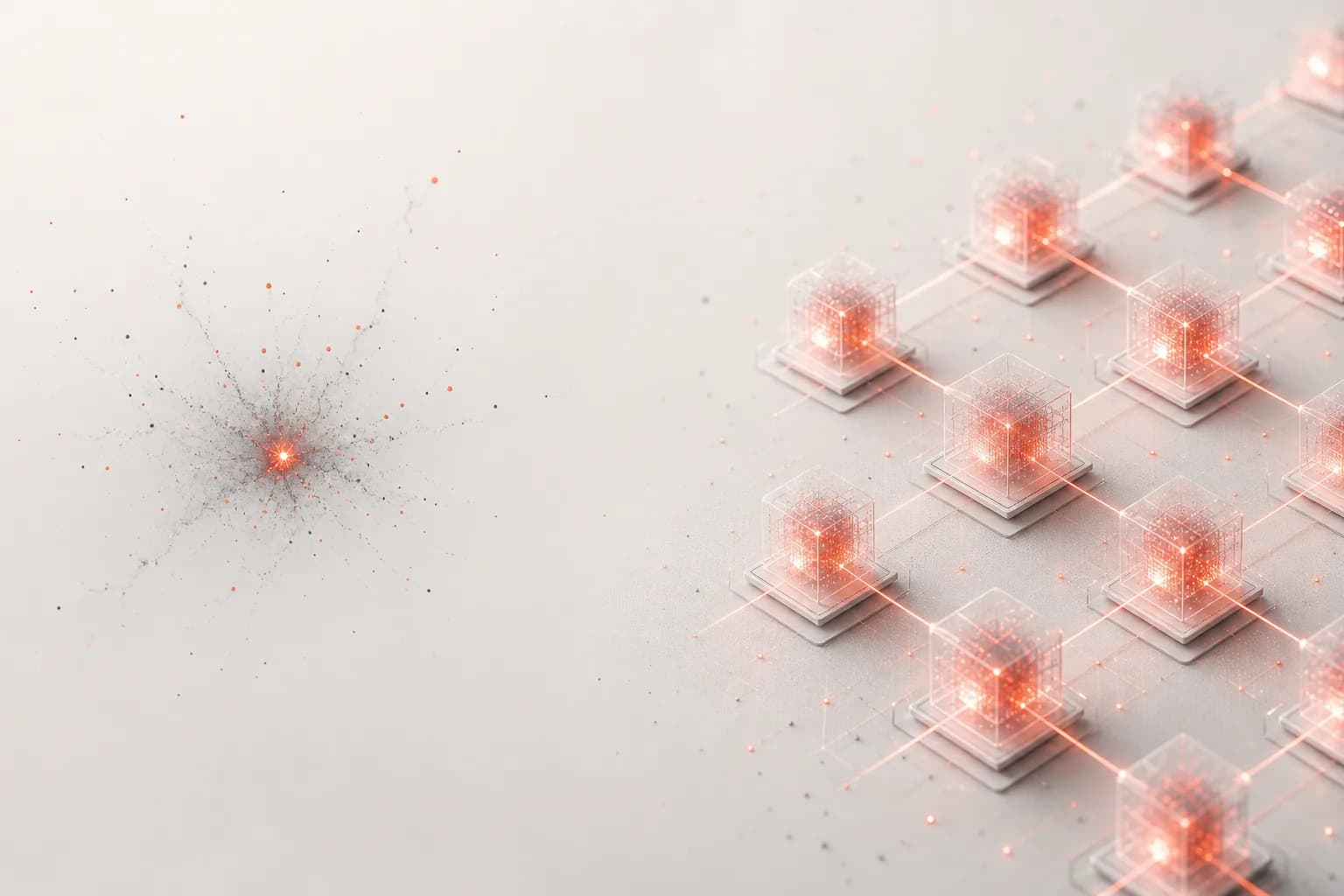
There is a moment every team using generative AI eventually reaches. You type a prompt, you get something beautiful, and you cannot make it again. The next prompt produces a different face, a different lighting, a different mood. The magic that felt like superpower a minute ago suddenly feels like a slot machine. For one-off content, that is fine. For anything you intend to ship at scale — a campaign, a series, a product catalog, a multi-episode story — it is a structural problem.
That problem is the reason I think the era of the single prompt box is ending, and the era of the AI creation workflow is beginning. This essay is about why, and about a less obvious consequence: the same shift that makes AI creation reliable is also what makes it discoverable in a world where AI answer engines, not blue links, increasingly decide what gets seen.
The limits of the one-off prompt
The text-box-to-image (or text-box-to-video) interface was a brilliant on-ramp. It made generative AI legible to everyone. But as a production tool it hits four walls quickly.
No reproducibility. A prompt plus a random seed is not a recipe; it is a roll of the dice. You cannot reliably regenerate last week's hero image with a small tweak, because the path that produced it was never captured as an artifact you can re-run.
No consistency across a series. The single most common request in real creative work — "make it again, but the same character, different pose" — is precisely what a stateless prompt cannot guarantee. Every generation starts from zero.
Hard to iterate. Improving a result means rewriting the whole prompt and praying. There is no notion of changing step three while holding steps one, two, and four constant.
Model lock-in. When your entire creative process lives inside one model's prompt box, you inherit that model's weaknesses everywhere. The model that writes great text-to-image is rarely the best at lip-sync, and almost never the best at video motion.
None of these are prompt-engineering problems. You cannot prompt your way out of a missing architecture. What is missing is orchestration — and orchestration is a product, not a prompt.
Composable workflows: the next stage
The answer that is emerging across the industry is the same answer software engineering reached decades ago: when a single step is unreliable, you build a pipeline of specialized steps you can re-run, version, and share. Composable AI creation does exactly this. You chain specialized models into a directed pipeline, and the pipeline — not any one model — becomes the thing you own.
This is how Floniks is built. The workflow editor is a node-based canvas where you connect models into a DAG (a directed acyclic graph). A real pipeline might look like: clean and upscale a source image, animate it into a clip, lip-sync the character to a voice track, burn in subtitles, then batch-render a dozen variations for A/B testing. Each node is a discrete, inspectable step. Change one node and re-run; the rest stays put. We went deeper on the mechanics in Inside the Workflow Editor, but the conceptual leap is simple: the unit of creation moves from the prompt to the graph.
Because the graph is the artifact, you get the properties one-off prompting cannot offer for free. A workflow can be saved, duplicated, versioned, and handed to a teammate who runs it without re-deriving your prompt incantations. Reliability and orchestration become the deliverable.
Pick the best model per step, not per platform
The most underrated benefit of a workflow canvas is multi-model freedom. Floniks orchestrates across providers — FAL.ai, MiniMax, Hailuo, Volces, APImart — inside a single canvas. That means you can route each step to whichever model is genuinely best at it. Use Seedance 2.0 where you need video motion, OmniHuman v1.5 where you need lip-sync, and something else entirely for the still frames, all wired together in one pipeline.
This is the opposite of lock-in. The frontier moves monthly; a new state-of-the-art video model appears and you want to swap it into step four without rebuilding steps one through three. A composable, multi-model AI architecture treats models as interchangeable components rather than walled gardens. Your investment lives in the workflow, not in any single vendor's roadmap.
Consistency as a primitive, not a prayer
This is where workflows stop being a convenience and start being a capability one-off prompts structurally cannot match. Floniks ships consistency primitives that only make sense when creation is stateful:
- characterRegistry keeps the same character coherent across shots, scenes, and episodes — the foundation for serialized content. We walk through this in multi-episode AI stories.
- styleLock holds a visual style constant across an entire batch, so the tenth render belongs to the same world as the first.
- consistencyEval automatically scores how consistent outputs are, turning "does this look right?" from a gut call into a measurable signal.
You cannot bolt these onto a stateless prompt. They require a system that remembers what it made and can evaluate the next thing against it. That is a workflow's home turf.
Reliability is the boring feature that matters most
The unglamorous part is what makes any of this trustworthy at scale. Generations fail — models time out, providers hiccup, parameters collide. Floniks treats reliability as a first-class feature: automatic credit refunds when a generation fails, unified pre-flight validation that catches bad parameters before a job is submitted, and real-time status so you are never guessing whether a node is stuck or working. None of this is flashy. All of it is the difference between a demo and a dependable tool. AI workflow automation is only worth building if it does not quietly bankrupt you on failed jobs or leave you blind to what went wrong.
The agent and GEO angle
Here is the part I find most interesting strategically, because two trends that look unrelated are actually the same trend.
Workflows are how AI agents will create. An agent — Claude, or any capable model with tools — does not want a prompt box. It wants a callable capability with a contract: inputs, outputs, status, cost. A single model is a thin tool; a whole pipeline is a meaningful one. Floniks exposes its creation engine as a Model Context Protocol server, plus a REST API and public Skills, so an agent can invoke an entire workflow — clean, animate, lip-sync, render — as one orchestrated action rather than babysitting each model call. The Model Context Protocol is quietly becoming the USB-C of agent tooling, and exposing composable capabilities through it is how creation tools stay relevant in an agent-driven world. Composable AI and AI agents are two sides of one coin: agents need composable building blocks, and composable building blocks are most powerful when an agent can call them.
Now the second trend, which closes the loop. As discovery shifts from search results to AI answer engines — ChatGPT Search, Perplexity, Google AI Overviews, Claude — the rules of being found are changing. This is what people mean by generative engine optimization (GEO), sometimes called answer engine optimization, or AEO. Classic SEO optimized pages to rank in a list of links. GEO optimizes content to be understood, trusted, and cited by a model that is synthesizing an answer rather than returning a list.
What does an answer engine reward? Content that is machine-readable, structured, and reproducible — because a model citing you needs to parse your claims, verify they are consistent, and trust they will still be true tomorrow. That is why Floniks invests in the GEO layer directly: an llms.txt file that tells models how to read the site, /answers direct-answer pages written to be quoted, and JSON-LD structured data that makes facts machine-parseable rather than locked in prose.
The connection to workflows is not a coincidence. The same discipline that makes creation reproducible — structured artifacts, stable contracts, machine-readable definitions — is the discipline that makes content citable by AI. A brand that already thinks in terms of versioned, structured, reproducible workflows is a brand already fluent in what GEO demands. One-off, unstructured, irreproducible output is exactly what answer engines struggle to cite, and exactly what agents cannot reliably call. The architecture that fixes the creative problem also fixes the discovery problem.
Where this goes next
My measured take: the next few years of AI creation belong to systems that are composable, multi-model, and agent-callable — and the winners will be the ones that treat reliability and structure as features rather than afterthoughts. The single prompt box will not disappear; it remains a wonderful sketchpad. But serious creation, the kind that ships as a series, a campaign, or a catalog, will move onto pipelines you can re-run, version, share, and hand to an agent.
The strategic insight for founders, marketers, and content leads is to stop thinking of AI as a magic prompt and start thinking of it as infrastructure. The teams that build (or adopt) composable workflows will out-iterate the teams still rerolling prompts — and, almost as a side effect, they will be the teams whose work is structured enough for the next generation of answer engines to cite. If you want the fuller picture of where we are headed, Introducing Floniks lays out the philosophy. The short version: the prompt was the on-ramp. The workflow is the road.
Frequently Asked Questions
What is an AI creation workflow?
An AI creation workflow is a pipeline of specialized AI steps — chained as a graph — that you can re-run, version, and share, rather than a single prompt producing a single output. In Floniks, you build these visually in the workflow editor, connecting models so each step (clean, animate, lip-sync, render) feeds the next.
What is generative engine optimization (GEO)?
Generative engine optimization, or GEO (closely related to answer engine optimization, AEO), is the practice of structuring content so AI answer engines like ChatGPT Search, Perplexity, Google AI Overviews, and Claude can understand, trust, and cite it. Where SEO optimized for a ranked list of links, GEO optimizes for being quoted inside a synthesized answer — which rewards machine-readable, structured, reproducible content.
Why are multi-model workflows better than a single model?
No single model is best at everything. A multi-model workflow lets you route each step to the strongest model for that task — for example, one provider for video motion and another for lip-sync — and swap any model as the frontier moves, without rebuilding the rest of the pipeline. This avoids vendor lock-in and keeps your investment in the workflow rather than one tool.
How do AI agents use AI creation workflows?
Through callable interfaces. Floniks exposes a Model Context Protocol server, REST API, and public Skills so an agent like Claude can invoke an entire pipeline as one orchestrated action — not just a single model call — passing inputs and receiving outputs, status, and cost back through a clean contract.