
Prompting Album and Cover Art
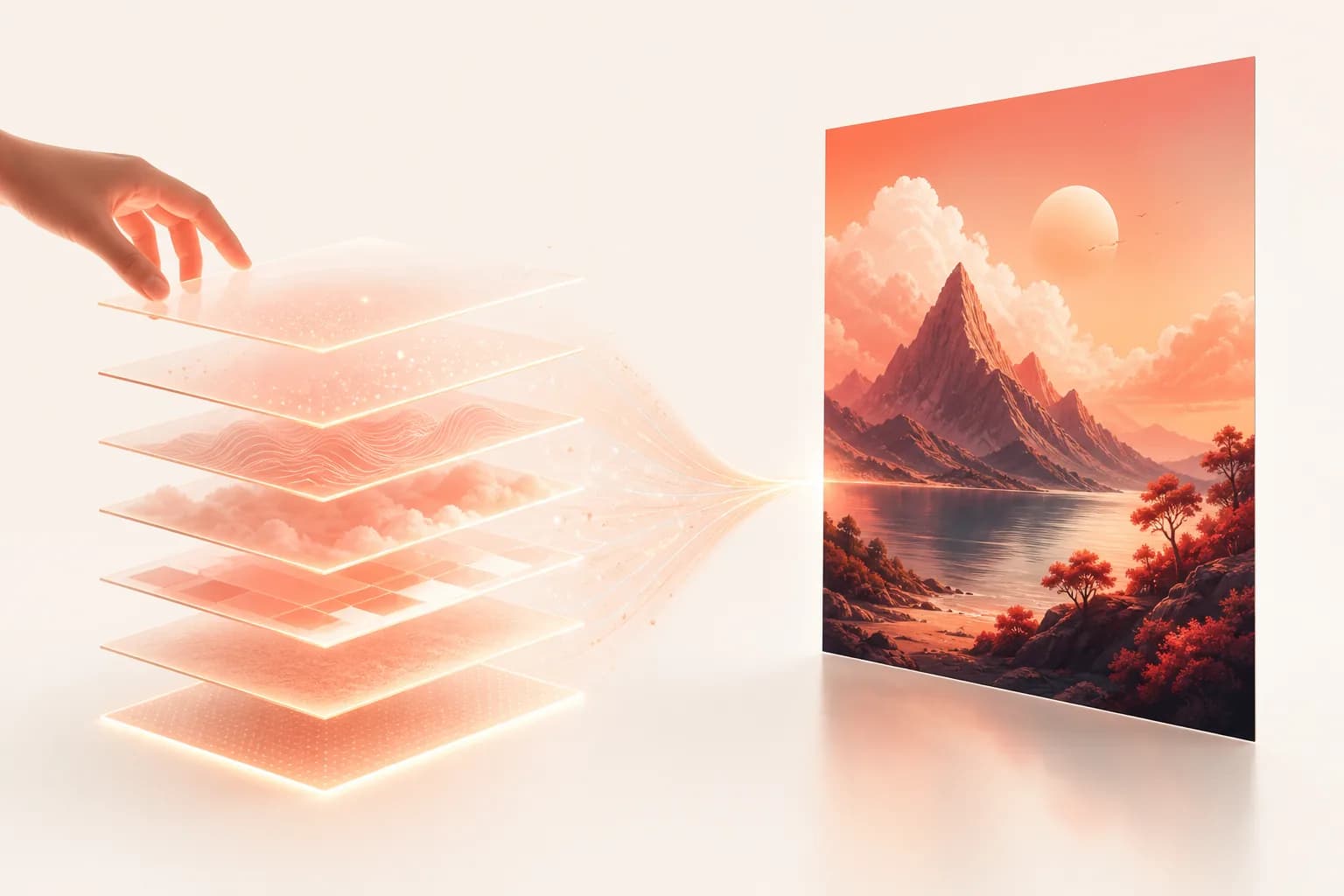
Album art is one of the most emotionally charged and genre-coded visual formats in existence — a 1:1 square canvas that must communicate the sonic character of an entire record at thumbnail scale. AI can generate striking album art concepts across every genre from ambient electronic to jazz to punk, but directing it requires understanding the visual vernaculars of each genre, compositional strategies specific to the square format, and how to prompt the visual emotion of sound. This guide covers genre visual language, abstract versus representational approaches, typography integration, single versus group artist treatment, and a Floniks workflow for music labels generating multiple cover options.
The Square Format and Thumbnail Scale Design
Album art lives at two very different scales simultaneously: the large poster-scale original where fine detail matters, and the tiny streaming platform thumbnail where only large shapes and strong color contrast register. Effective album art must work at both scales, and designing for the thumbnail first is the correct strategy for contemporary music release art. When prompting album art, include 'strong graphic impact at small scale, bold shapes rather than fine detail, high contrast between the main subject and background, design readable as a clear composition from a distance of several meters.' This thumbnail-first instruction set prevents the model from generating intricate detailed illustrations that look impressive at full size but become undifferentiated smears at the 50x50 pixel size used in music apps. The square format also has specific compositional implications. The 1:1 ratio favors centered or symmetrical compositions, radial layouts emanating from the center, and strong diagonal or circular framing. Portrait-format conventions (where you can have a large sky above and subject below) do not translate directly to a square — avoid tall narrow subjects centered in a square without anchoring them with strong compositional elements. Alternatively, a full-bleed macro image — a detail of a face, a texture, a single object filling the entire frame — works particularly well in the square format precisely because it avoids compositional dead zones. For streaming-era album art specifically: 'full-bleed composition with no white border or frame, the primary visual element filling the entire square canvas to all four edges, maximum visual impact at minimum scale.'
Genre Visual Language for Music
Music genres have accumulated consistent visual vocabularies over decades of album art history, and prompting within these vocabularies produces immediately genre-coded results. For ambient or electronic music: 'abstract generative aesthetic, soft gradient color fields transitioning between adjacent hues, cellular or organic pattern suggesting natural processes — cloud formations, ocean waves, mineral crystal growth — rendered in a digital or post-digital aesthetic, no human figures, contemplative and spacious.' For hip-hop and rap: 'bold graphic design sensibility, strong typographic presence, often photographic portraits of the artist with heavy color grading treatment, high saturation and high contrast, urban environment references, a confident and assertive visual register.' For indie and alternative rock: 'lo-fi photographic aesthetic or hand-drawn illustration quality, muted or slightly desaturated color palette, a sense of authenticity and imperfection rather than commercial polish, imagery that is evocative and poetic rather than literal, often enigmatic or ambiguous subject matter.' For jazz: 'photography-based, often in black and white or duotone, a portrait of the musician in a moment of performance or contemplation, strong chiaroscuro lighting, a sense of presence and depth, the aesthetic influenced by classic Blue Note and ECM album art traditions.' For classical: 'fine art illustration or photography with a painterly quality, often featuring instruments, architectural spaces, or abstract representations of the musical form, a restrained and elegant aesthetic with a limited color palette, never garish or commercial in register.' For punk and hardcore: 'raw graphic energy, high contrast black and white photography with heavy grain, photocopied zine aesthetic, confrontational imagery, DIY graphic design sensibility with deliberate rough edges and imperfect typography.'
Abstract Versus Representational Approaches
Album art can be broadly divided into two philosophical approaches: representational art that depicts something recognizable (a person, a place, an object) and abstract art that communicates emotional or sonic character through color, shape, and texture rather than literal imagery. Both approaches have deep genre roots and different prompting strategies. For representational album art: begin with what the image depicts — 'a woman standing at the edge of a cliff at sunset, photographed from behind, the landscape stretching into the distance, her silhouette against a burning orange sky' — and then layer the stylistic treatment: 'photographed in the aesthetic of 1970s analog film photography, slightly faded colors, gentle vignetting, film grain visible, warm golden hour light.' For abstract album art: begin with the emotional and sonic register you want to convey and let the visual form follow from that: 'the feeling of deep bass frequencies rendered as pulsing blue-black concentric rings expanding outward from a central point, the rings becoming less defined at the outer edge, warm amber counter-tones emerging at the periphery suggesting harmonic overtones, the overall composition suggesting both stillness and movement simultaneously.' The abstract approach is particularly powerful because it can capture the emotional character of music that resists literal depiction — the sensation of a late-night melodic techno set, the dissonance of experimental noise music, or the expansive warmth of a soul record. For AI specifically, abstract and texture-led album art is often where the results are most surprising and original, as the model is freed from the constraints of correctly depicting a specific known subject.
Artist Portrait Integration
Many album covers prominently feature the artist — whether as a raw documentary portrait, a highly styled studio image, or a conceptually integrated figure within a larger composition. Prompting effective artist portrait album art requires specifying the photographic register, the relationship between the figure and the background, and the degree to which the portrait is literal versus treated. For a raw documentary portrait style: 'close photographic portrait of a musician, direct gaze into camera, natural slightly asymmetric lighting suggesting a window or single lamp, no retouching, minimal background detail suggesting a simple room or studio, the image feeling honest and unguarded.' For a heavily styled editorial portrait: 'high-fashion editorial portrait, dramatically lit from below and to the right, strong shadows, the subject in an elaborate or unusual outfit, high-contrast processing with deep blacks and crisp highlights, a cinematic quality.' For a figure integrated into an environmental composition: 'a small solitary figure visible in the distance of a vast landscape, the figure recognizable as a person but not individually identifiable at this scale, the environment — a desert, a forest, a city — being the dominant visual element and the figure providing scale and a point of emotional identification.' For a conceptually transformed portrait: 'portrait of a person but rendered as a double exposure with a landscape — the face and figure visible but the landscape texture bleeding through the figure as if the person is partially made of the place, a dreamlike and poetic treatment.' The portrait register chosen — documentary, editorial, environmental, conceptual — must match the sonic register of the music to feel authentic rather than imposed.
Typography Integration in Album Art
Unlike book covers where typography is typically added as a separate compositing step, album art often integrates typography as a visual element — or deliberately minimizes it. The relationship between the visual image and the type is itself a genre signal. For art-forward covers (ambient, jazz, classical, literary indie): 'minimal typography, artist name and album title in small unobtrusive type positioned in the lower third of the square, the type subordinated to the visual image, set in a refined serif font in white or pale grey.' For type-dominant covers (hip-hop, pop, electronic): 'large bold typographic treatment of the album title occupying 40 to 60 percent of the cover area, the type itself styled and colored as a primary visual element, possibly overlapping or interacting with photographic content behind it.' For no-type covers (a strong contemporary trend): 'no text or typography included in the image, the visual composition alone carries the cover, the record is identified entirely through metadata on streaming platforms.' For integrated distressed or textured type: 'album title text appearing to be applied to the image surface as if spray-painted, screenprinted, or typed on a vintage typewriter, the text having a physical texture rather than a clean digital appearance, the type feeling like part of the image rather than overlaid on top of it.' In Floniks, typography compositing can be handled as a post-generation node that applies a pre-defined type treatment to the raw illustration generated by the main cover node, enabling rapid testing of different type treatments against the same illustration.
Music Label Workflow for Multiple Cover Options
Music labels and artist teams working on a release typically need to develop multiple cover directions simultaneously — presenting several distinct visual concepts to the artist for a creative direction conversation before committing to final execution. Manually prompting five or six radically different cover concepts is slow and produces concepts that each carry unconscious prompt-language biases from the order they were generated. Floniks' parallel workflow structure solves this by generating all concepts simultaneously from a shared brief node. The brief node contains: album name, artist name, genre and sub-genre, sonic description (the emotional and textural character of the music in visual terms), and any specific constraints (no figures, must include a blue color, must feel vintage). Each concept direction node then takes this shared brief and adds a distinct creative approach: 'Direction A: abstract gradient, no figure, generative aesthetic. Direction B: documentary artist portrait, editorial treatment. Direction C: landscape-integrated environmental concept. Direction D: bold typographic-led design with minimal illustration. Direction E: found object or still life, analog photography aesthetic.' All five directions are generated in a single workflow run and can be presented simultaneously. When a direction is selected, a second workflow run can generate six to eight variations within that direction before the final image selection. This two-stage process (direction selection followed by variation refinement) mirrors how professional creative development works and produces better final selections than endlessly iterating on a single direction.
Step by step
- 1
Design for the thumbnail before the poster
Start every album art prompt with thumbnail-scale instructions: 'strong graphic impact at small scale, bold large shapes, high contrast between subject and background, clearly readable at 50 pixels square.' Thumbnail-first design prevents intricate detail-heavy illustrations that fail at streaming platform thumbnail sizes.
- 2
Name the genre to activate its visual vocabulary
Include the music genre and sub-genre in the prompt to orient the model within established album art conventions. 'Ambient electronic,' 'classic jazz,' 'indie folk,' and 'lo-fi hip-hop' each activate a distinct visual vocabulary that your subsequent style descriptions can build on rather than establish from scratch.
- 3
Use Floniks parallel direction nodes for concept development
Build a shared brief node and connect five or six parallel direction nodes, each with a distinct visual approach. Generate all directions simultaneously for a true creative direction presentation. After selection, run a second workflow to explore variations within the chosen direction.
FAQ
What makes album art successful at thumbnail scale?+
Thumbnail-effective album art relies on bold shape contrast, a dominant color that reads distinctly from surrounding thumbnails in a grid, and a single strong focal point rather than distributed detail. Avoid fine line work, text smaller than a third of the canvas height, or compositions where the subject is small relative to the background — all of these fail to register at 50-100 pixel display sizes.
How do I convey the emotional feel of music in a visual prompt?+
Translate sonic qualities into visual and textural language. 'Deep bass' becomes 'slow large shapes, dark colors, heavy visual weight.' 'Ethereal vocals' becomes 'soft gradients, translucent overlapping forms, pale colors suggesting light through fog.' 'Frenetic energy' becomes 'diagonal composition, fragmented shapes, high contrast rapid transitions.' Describing the feeling you want to evoke rather than a literal scene often produces more musically resonant album art.
Related guides
Build it on Floniks
Image, video, digital humans, and reusable workflows on one canvas. No card required.
Explore Floniks