
Prompting Double-Exposure and Composite Effects
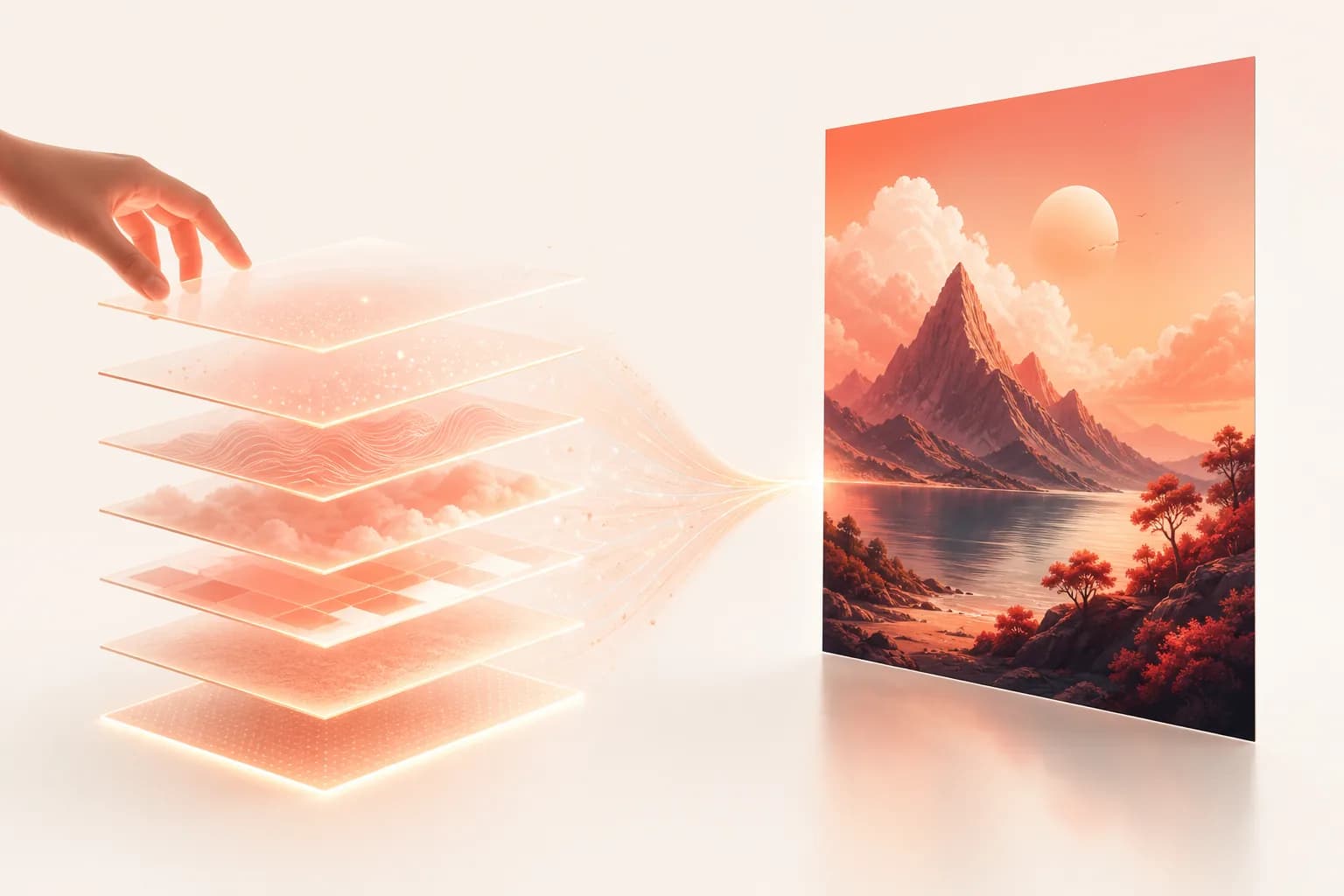
Double-exposure compositing — the layering of two distinct visual worlds within a single silhouette — demands specific prompting vocabulary that describes the blend relationship between the two images rather than describing them as separate scenes. Without precise language, AI models generate something vaguely overlapping rather than the deliberate, graphic double-exposure effect where a portrait silhouette reveals a landscape inside it. This guide covers the full vocabulary for prompting double exposure, silhouette-reveal composites, light-leak overlays, and multi-layered conceptual images — plus Floniks workflow strategies for building composites that go beyond single-generation capability.
Describing the Double-Exposure Relationship
The double-exposure effect is defined by a specific spatial relationship between two images: one image — typically a portrait or strong silhouette — acts as a containing shape, while the second image — typically a landscape, cityscape, or natural environment — is revealed through and within the silhouette of the first. The key is that the relationship must be described as a containment or reveal, not as two separate overlapping images. Effective framing: 'double exposure portrait, woman's profile silhouette containing a dense forest reflected inside it, trees and light filtering through the silhouette boundary, dark background outside the silhouette, seamless blend within the face/hair boundary.' What fails: 'woman and forest overlapping.' The latter describes two coexisting elements with no defined spatial hierarchy; the former describes a specific figure-ground relationship where the silhouette is the containing vessel. The tonal relationship also matters: double exposure traditionally works within a monochromatic or limited-palette framework because the two images share tonal space. Specifying this: 'monochromatic blue double exposure, woman's silhouette filled with ocean waves, shared blue tonal palette, background fades to near-white, high contrast silhouette edge.' The simpler and more graphic the silhouette, the more readable the composite — a clean profile portrait works better than a complex 3/4 view pose with loose hair that creates an irregular, hard-to-read containing shape.
Blend Mode Vocabulary for Composites
Traditional double exposure creates its look through the multiply, screen, or overlay interaction of two photographic exposures. In prompting, you can describe these blend mode interactions to guide the model toward specific visual results. Screen-style blend (lighter areas from each image dominate, darks become transparent): 'screen blend double exposure, highlights from both images visible simultaneously, dark areas of each image become transparent revealing the other, airy luminous result, two images sharing the same light space.' Multiply-style blend (darks from each image dominate, lights become transparent): 'multiply double exposure, deep shadow areas from both images reinforced, lighter areas transparent, results in rich dark composite with high contrast.' Overlay-style blend (contrast and saturation from both images amplified): 'high contrast composite, colors from both images saturated and intensified where they overlap, graphic punchy quality.' Hard light composite for dramatic graphic effect: 'graphic composite, sharp silhouette boundary, hard transition between interior and exterior, no soft blending at edge, clean graphic design aesthetic.' Beyond blend mode description, you can specify luminosity zones: 'light areas of the cityscape visible within dark areas of the portrait, shadow areas of the portrait revealing lighter parts of the landscape, tonal inversion creating visual dialogue between the two subjects.' Blend mode descriptions are more precise than naming the mode directly, since the model understands the visual result better than it understands software layer mode terminology.
Light Leaks, Film Burns, and Analog Overlay Effects
Double exposure exists within a broader family of analog photographic overlay effects that AI models can simulate when prompted with specific physical descriptions. Light leaks are a film photography artifact where light enters the camera body and exposes areas of the film: 'light leak effect, horizontal streaks of warm orange and red light across the upper right and lower left corners, irregular organic shape, bokeh halos along the streak edge, film photography aesthetic.' Film burns — where film is exposed to direct light — produce more dramatic full-frame color shifts: 'film burn effect, deep magenta and violet wash across the lower third fading to natural color in the upper half, edge-heavy, organic vignette.' Double-exposure on color film produces unique color mixing effects: 'double exposure on color negative film, portrait of a woman with autumn forest, warm orange and red foliage tones mixing with skin tone, desaturated background, filmic grain throughout, Kodak Portra color response.' Prism or lens flare composites introduce prismatic color fringing: 'prism effect composite, rainbow chromatic fringing along the silhouette edge, light refracted into spectral bands at the boundary between subject and background, psychedelic analog aesthetic.' Each of these effects has a specific physical mechanism, and describing that mechanism — rather than just naming the effect — produces more convincing and controllable simulation results in AI image generation.
Conceptual Composites and Metaphorical Layering
Beyond the photographic double-exposure tradition, AI enables a wider class of conceptual composite images where two or more visual elements are merged to communicate an idea or metaphor. These conceptual composites require prompting the semantic relationship between the elements, not just their visual overlap. Identity and place: 'silhouette of a person filled with the skyline of their home city at dusk, sense of belonging and identity, warm city lights inside the dark human silhouette, fade to deep blue outside.' Transformation concept: 'half portrait of a young woman merging into autumn leaves, face dissolving into falling leaves from the cheekbone upward, warm golden and amber tones, soft photographic quality, seamless organic transition.' Mind and nature: 'open human head silhouette filled with a stormy sky and lightning, the weather contained within the mind, dramatic dark clouds inside the cranium, calm exterior background in contrast.' Time and memory: 'double exposure of an old abandoned house and a childhood portrait, nostalgic and melancholy tone, sepia-tinted, both images sharing the same tonal space, past overlaid on present.' These conceptual prompts require specifying both the visual mechanics of the composite and the semantic intent — what the image is meant to communicate — because the model draws from both the visual and the conceptual dimensions of its training to produce images that feel intentional rather than random.
Multi-Layer Composite Workflows in Floniks
Single-generation double-exposure images are compelling but limited — the model must both create the two source images and composite them in a single step, which often compromises the quality and specificity of each element. The Floniks workflow editor enables a more controlled multi-step approach that generates each element separately and then composites them, giving you independent control over each layer's quality. Step one: generate the silhouette subject — a clean portrait or graphic shape on a solid background, prompted for crisp edge definition and strong tonal contrast. Step two: generate the environment or secondary image separately, optimized for the interior of the composite — high tonal range, relevant color palette, appropriate detail density. Step three: route both into a compositing node that applies the blend mode and silhouette masking. This three-node approach consistently outperforms single-step double-exposure generation in terms of control, quality, and repeatability. For complex composites with three or more layers — portrait, landscape, light leak, and color grade — each layer can be optimized and generated independently before being composited in sequence. Store the composite workflow as a template and reuse it across different portrait/environment combinations, varying only the source image descriptions while keeping the compositing logic constant.
Related guides
Build it on Floniks
Image, video, digital humans, and reusable workflows on one canvas. No card required.
Explore Floniks